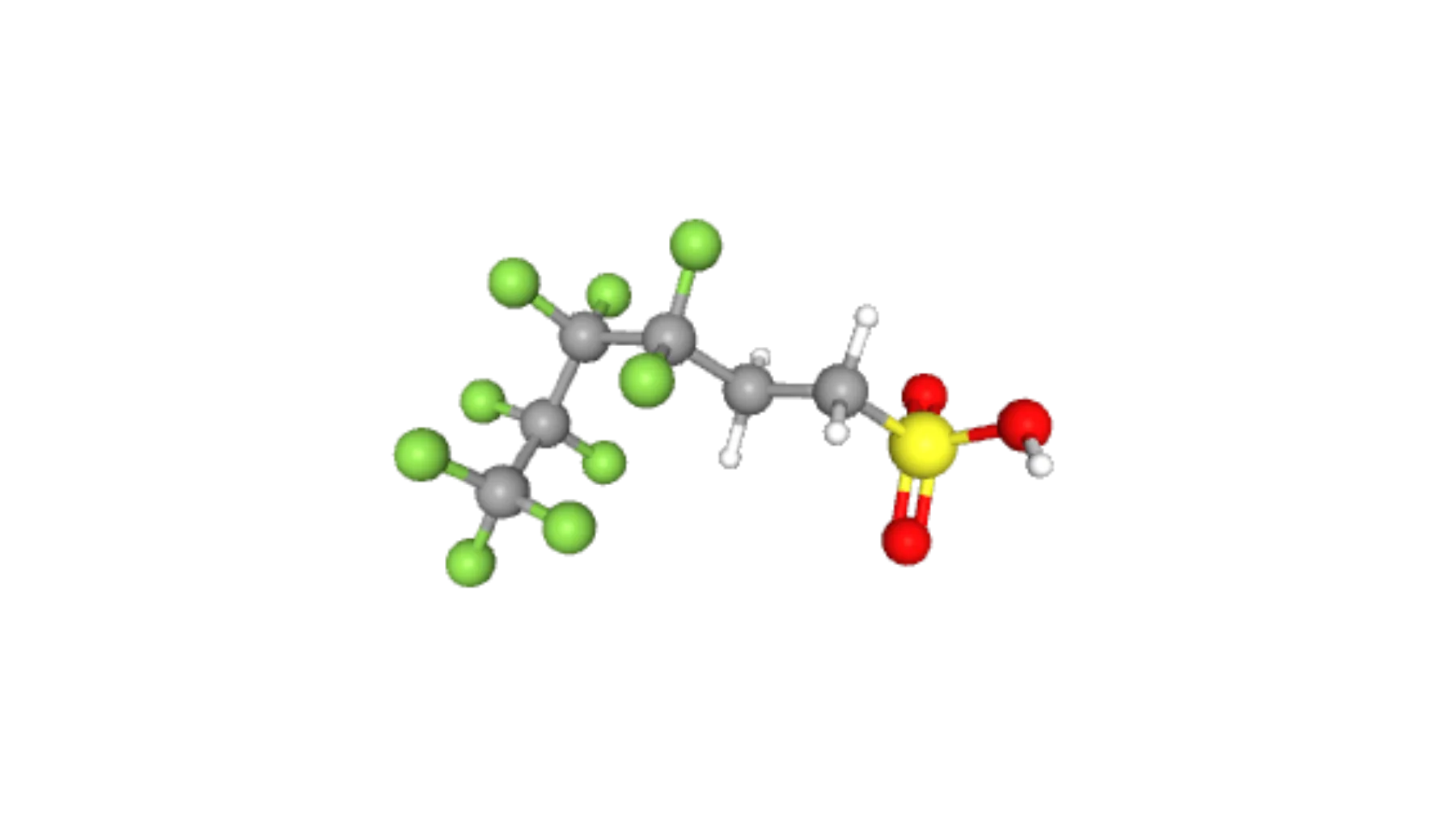
4:2 FTS
4:2 Fluorotelomer Sulfonic Acid
3,3,4,4,5,5,6,6,6-nonafluorohexane-1-sulfonic acid
A short-chain fluorotelomer sulfonic acid (4 perfluorinated + 2 alkyl carbons), formed as a degradation product of fluorotelomer-based aqueous film-forming foam (AFFF). Detected at low ppt levels in U.S. drinking water under UCMR 5.
Primary concern: Immune and liver toxicity
Affected organ systems
Health effects
Exposure routes
Vulnerable populations
Overview
4:2 Fluorotelomer sulfonic acid (4:2 FTS or 4:2 FTSA) is a short-chain fluorotelomer sulfonic acid consisting of a perfluorinated four-carbon tail (C4F9) bonded to a two-carbon CH2CH2- spacer terminating in a sulfonic acid head group. It belongs to the broader class of fluorotelomer sulfonates (FTSs) that arose as PFAS chemistry shifted away from long-chain compounds like PFOS in the early 2000s. 4:2 FTS rarely appears as an intentional commercial product; instead, it forms in the environment as a degradation intermediate of fluorotelomer-based aqueous film-forming foam (AFFF) and other fluorotelomer raw materials. EPA added it to UCMR 5 in 2021 to characterize occurrence in U.S. drinking water.
Pollution sources
Sources
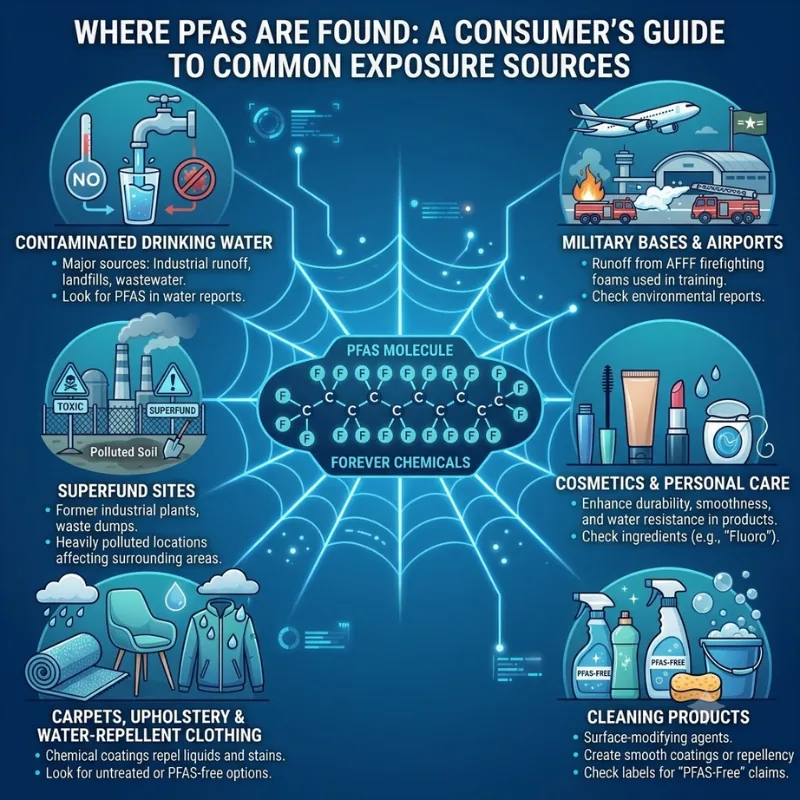
4:2 FTS enters drinking water primarily through historical use of fluorotelomer-based AFFF at military airfields, civilian airports, oil refineries, and fire-training facilities. Under aerobic and anaerobic soil conditions, the parent fluorotelomer thioether amido sulfonate (FtTAoS) and related precursors slowly biotransform into 4:2 FTS and other fluorotelomer sulfonate chain lengths. UCMR 5 detections so far cluster around AFFF source areas in Florida (Pensacola), Massachusetts (Canton), and New Hampshire (Jaffrey). Because FTSs are mobile in groundwater and resist further degradation, they migrate readily into source-water wells and surface intakes downstream of release sites.
Health risks
Toxicological data specific to 4:2 FTS are limited compared to PFOA and PFOS. The compound has not been formally classified as a carcinogen. However, structurally similar short-chain perfluoroalkyl sulfonates have been linked in animal and human studies to hepatotoxicity, thyroid hormone disruption, immune suppression, and developmental effects. Fluorotelomer sulfonates can also undergo further metabolic or environmental transformation into longer-lived perfluoroalkyl carboxylic acids, complicating risk assessment. 4:2 FTS is monitored under UCMR 5 but is not currently subject to a federal MCL.
Effective treatments
Does not remove
NSF certifications
Water treatment
4:2 FTS is removed by granular activated carbon (GAC), anion exchange resin, and high-pressure membranes including reverse osmosis and nanofiltration, though short-chain fluorotelomers tend to break through GAC media earlier than their long-chain counterparts. Anion exchange resins selective for short-chain PFAS offer better long-term performance for this class. Conventional treatment processes — coagulation, sand filtration, disinfection, UV, and ozonation — do not remove 4:2 FTS. Boiling concentrates rather than removes it. NSF/ANSI 53 and NSF P473 certify point-of-use filters for PFAS reduction; NSF/ANSI 58 covers RO systems.
Gallery
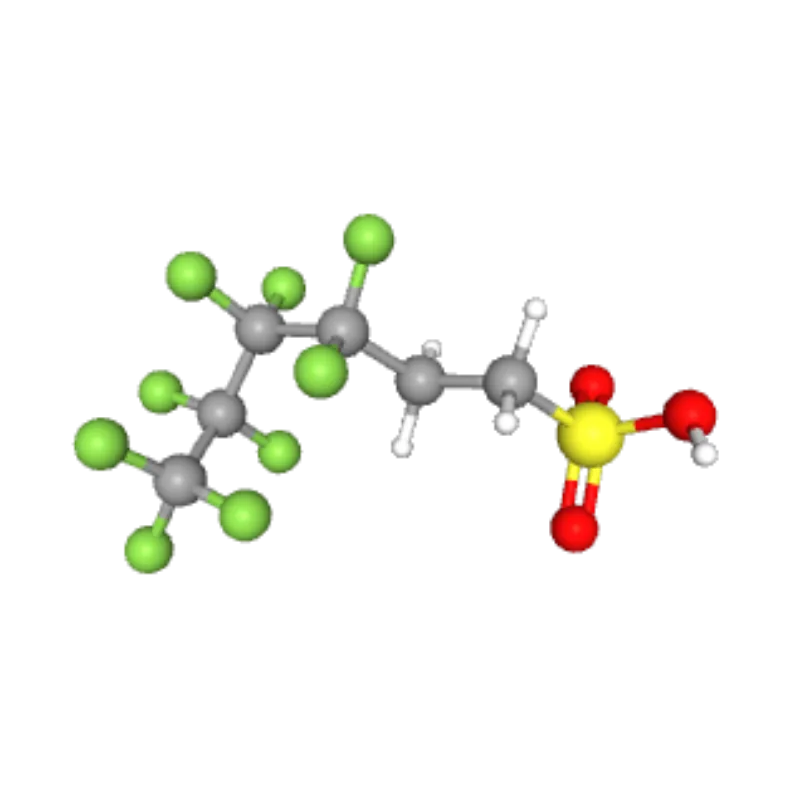
Chemistry + classification data sourced from public databases (PubChem, EPA CompTox, IARC monographs); 3D molecular models from 3d.nih.gov where available.