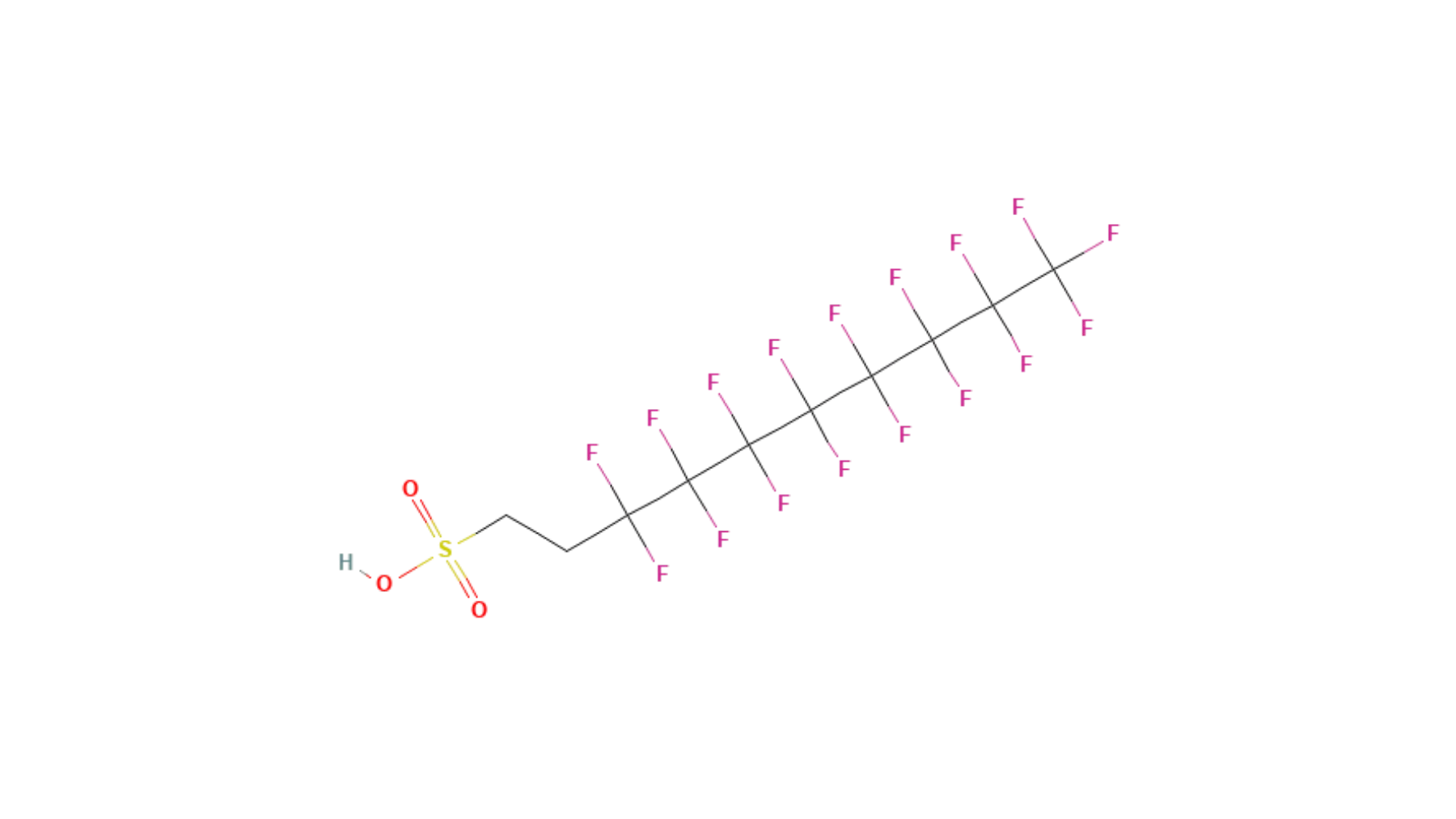
8:2 FTS
8:2 Fluorotelomer Sulfonic Acid
3,3,4,4,5,5,6,6,7,7,8,8,9,9,10,10,10-heptadecafluorodecane-1-sulfonic acid
A long-chain fluorotelomer sulfonic acid (8 perfluorinated + 2 alkyl carbons) used in legacy stain-resistant coatings and fluoropolymer manufacturing. Detected in 13 U.S. utilities serving ~2.5 million people under UCMR 5.
Primary concern: Immune and liver toxicity
Affected organ systems
Health effects
Exposure routes
Vulnerable populations
Overview
8:2 Fluorotelomer sulfonic acid (8:2 FTS or 8:2 FTSA) is a long-chain fluorotelomer sulfonic acid consisting of a perfluorinated eight-carbon tail (C8F17) bonded to a two-carbon CH2CH2- spacer terminating in a sulfonic acid head group. It belongs to the same fluorotelomer sulfonate family as 4:2 and 6:2 FTS but carries the longest perfluorinated chain in the FTS series monitored under UCMR 5. Historically, 8:2 fluorotelomer chemistry was used in stain-resistant coatings on textiles, paper, and carpet, and as a raw material in fluoropolymer manufacturing. Production has declined significantly in North America following the 2010-2015 PFOA Stewardship Program, but environmental residues persist and continue to surface in drinking water.
Pollution sources
Sources
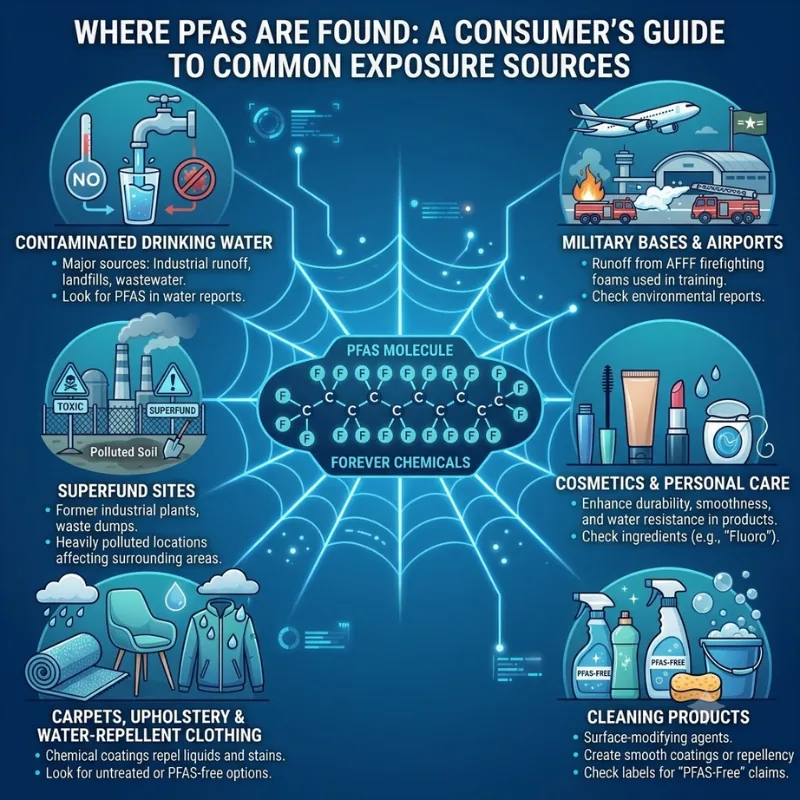
8:2 FTS enters drinking water through industrial discharges from facilities that historically manufactured or used long-chain fluorotelomer chemistry, runoff from sites where fluorotelomer-based aqueous film-forming foam (AFFF) was used, atmospheric deposition of fluorotelomer alcohol (8:2 FTOH) that oxidizes to 8:2 FTS in surface water, and leachate from landfills containing legacy stain-resistant consumer goods. UCMR 5 detections concentrate in Florida and Pennsylvania, with the highest concentrations near a Pennsylvania source in the Lehigh Valley. Long-chain fluorotelomers like 8:2 FTS are particularly concerning because they can biodegrade in the environment and human body into PFOA — a confirmed IARC Group 1 carcinogen — creating a continuing exposure pathway long after primary use ceases.
Health risks
Toxicological data on 8:2 FTS itself is more limited than for its degradation product PFOA. The parent compound has not been formally classified as a carcinogen, but it shares the persistence, bioaccumulation, and mobility hallmarks of long-chain PFAS. Animal studies have linked 8:2 fluorotelomer chemistry to hepatotoxicity, thyroid hormone disruption, and developmental effects. The most significant health concern is metabolic conversion: 8:2 FTS and the related 8:2 fluorotelomer alcohol can both biotransform into PFOA in mammalian tissue, effectively functioning as a PFOA precursor in human serum. 8:2 FTS is monitored under UCMR 5 but is not currently subject to a federal MCL.
Effective treatments
Does not remove
NSF certifications
Water treatment
8:2 FTS is removed effectively by granular activated carbon (GAC), anion exchange resin, and high-pressure membranes including reverse osmosis and nanofiltration. As a long-chain fluorotelomer, it adsorbs more strongly to GAC than short-chain FTS analogues like 4:2 and 6:2 FTS, giving longer column run times before breakthrough. Conventional treatment processes — coagulation, sand filtration, disinfection, UV, and ozonation — do not remove 8:2 FTS. Boiling concentrates rather than removes it. NSF/ANSI 53 and NSF P473 certify point-of-use filters for PFAS reduction; NSF/ANSI 58 covers RO systems.
Gallery

Chemistry + classification data sourced from public databases (PubChem, EPA CompTox, IARC monographs); 3D molecular models from 3d.nih.gov where available.