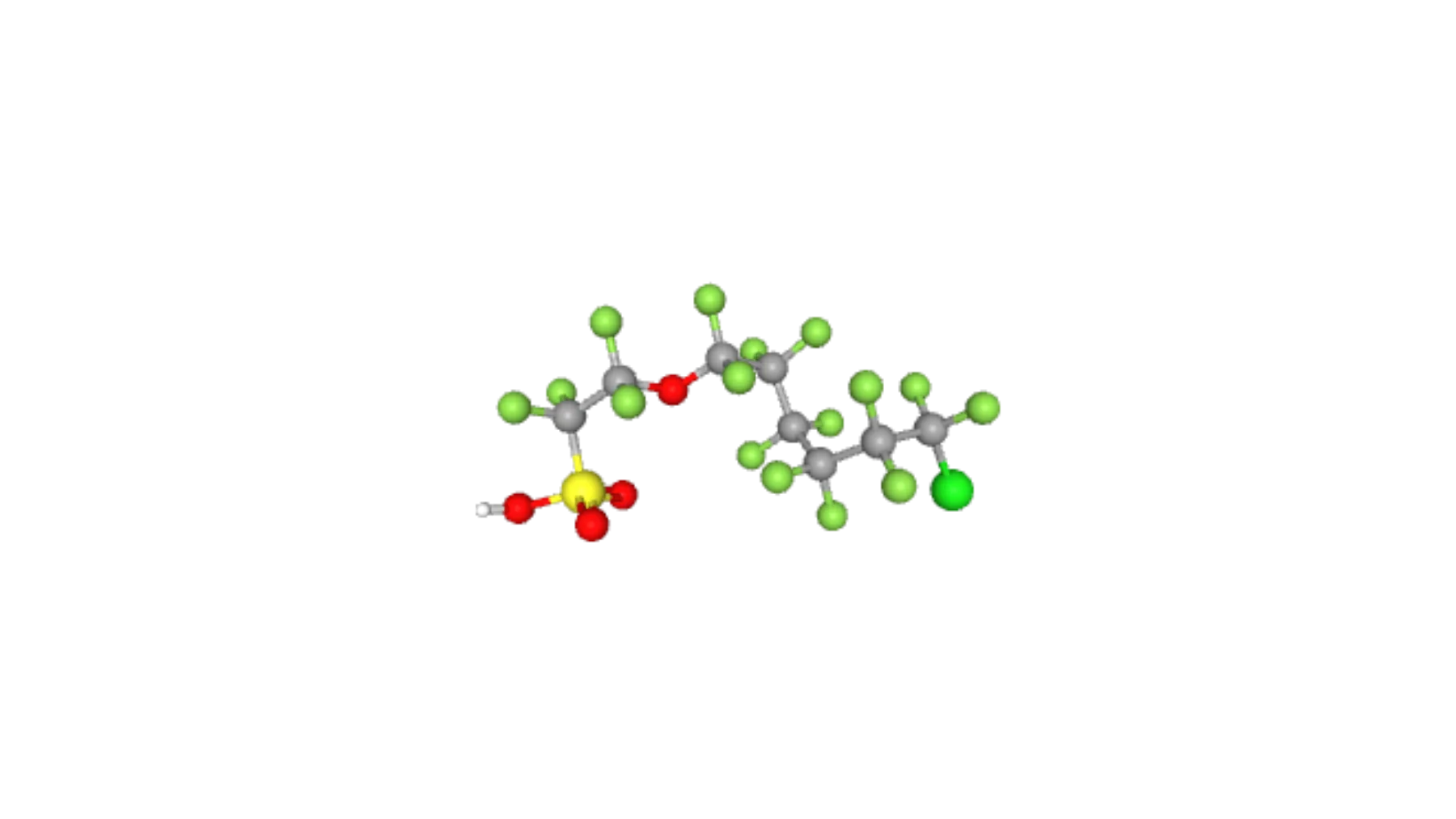
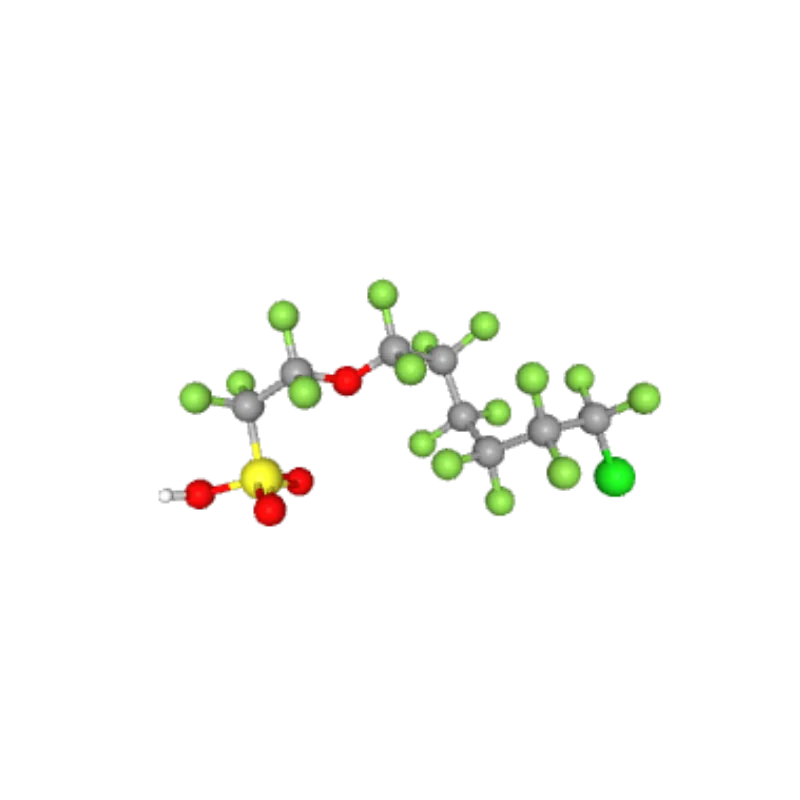
9Cl-PF3ONS
9-chlorohexadecafluoro-3-oxanone-1-sulfonic acid
2-(6-chloro-1,1,2,2,3,3,4,4,5,5,6,6-dodecafluorohexoxy)-1,1,2,2-tetrafluoroethanesulfonic acid
A chlorinated perfluoroether sulfonic acid (6:2 Cl-PFESA), the major component (~90%) of the Chinese-made F-53B chromium-plating mist suppressant. Persistent, bioaccumulative, and detected at low ppt levels under UCMR 5.
Primary concern: Immune and liver toxicity
Affected organ systems
Health effects
Exposure routes
Vulnerable populations
Overview
9-chlorohexadecafluoro-3-oxanone-1-sulfonic acid (9Cl-PF3ONS), also known as 6:2 Cl-PFESA, is a chlorinated perfluoroether sulfonic acid and the major component (~90%) of F-53B — a chromium-electroplating mist suppressant developed in China in the 1970s as a 'safer' replacement for PFOS in metal-finishing applications. The minor component of F-53B (~10%) is its longer-chain sibling 11Cl-PF3OUdS (8:2 Cl-PFESA). 9Cl-PF3ONS has been detected in surface water, drinking water, and human serum across multiple continents and was found in 42 U.S. public water systems serving roughly 130,000 people under EPA's UCMR 5 monitoring program, with the highest concentration (11.7 ppt) measured at Lincoln, Alabama.
Pollution sources
Sources
9Cl-PF3ONS enters drinking water primarily through industrial discharges from metal-finishing operations that historically used F-53B as a chromium mist suppressant. Although F-53B production and use have been concentrated in China, atmospheric long-range transport, imported consumer goods, and U.S. industrial emissions have produced detectable contamination in multiple regions. UCMR 5 detections so far cluster in Alabama, Oklahoma (Ponca City area), Massachusetts, and New York. As with other Cl-PFESAs, 9Cl-PF3ONS is highly mobile in groundwater and resists degradation indefinitely, allowing contamination plumes to migrate far from the original release sites.
Health risks
9Cl-PF3ONS has not been formally classified as a carcinogen by IARC or NTP, but it shares the structural and toxicological profile of other PFAS of concern. In animal and human studies, Cl-PFESAs have been linked to hepatotoxicity, thyroid hormone disruption, immune suppression, and adverse developmental effects. Occupational studies of F-53B-exposed Chinese electroplating workers documented serum elimination half-lives on the order of 15 years for 6:2 Cl-PFESA — substantially longer than PFOA (~2.4 years) or PFOS (~5.4 years), and among the longest measured for any PFAS in humans. This analyte is monitored under UCMR 5 but is not currently subject to a federal MCL.
Effective treatments
Does not remove
NSF certifications
Water treatment
9Cl-PF3ONS is removed effectively by granular activated carbon (GAC), anion exchange resin, and high-pressure membranes including reverse osmosis and nanofiltration. Its perfluorinated chain and chlorine substituent contribute to strong adsorption on GAC media. Conventional treatment processes — coagulation, sand filtration, disinfection, UV, and ozonation — do not remove it. Boiling concentrates rather than removes it. NSF/ANSI 53 and NSF P473 certify point-of-use filters for PFAS reduction; NSF/ANSI 58 covers RO systems.
Gallery
Related contaminants
Chemistry + classification data sourced from public databases (PubChem, EPA CompTox, IARC monographs); 3D molecular models from 3d.nih.gov where available.