ADONA
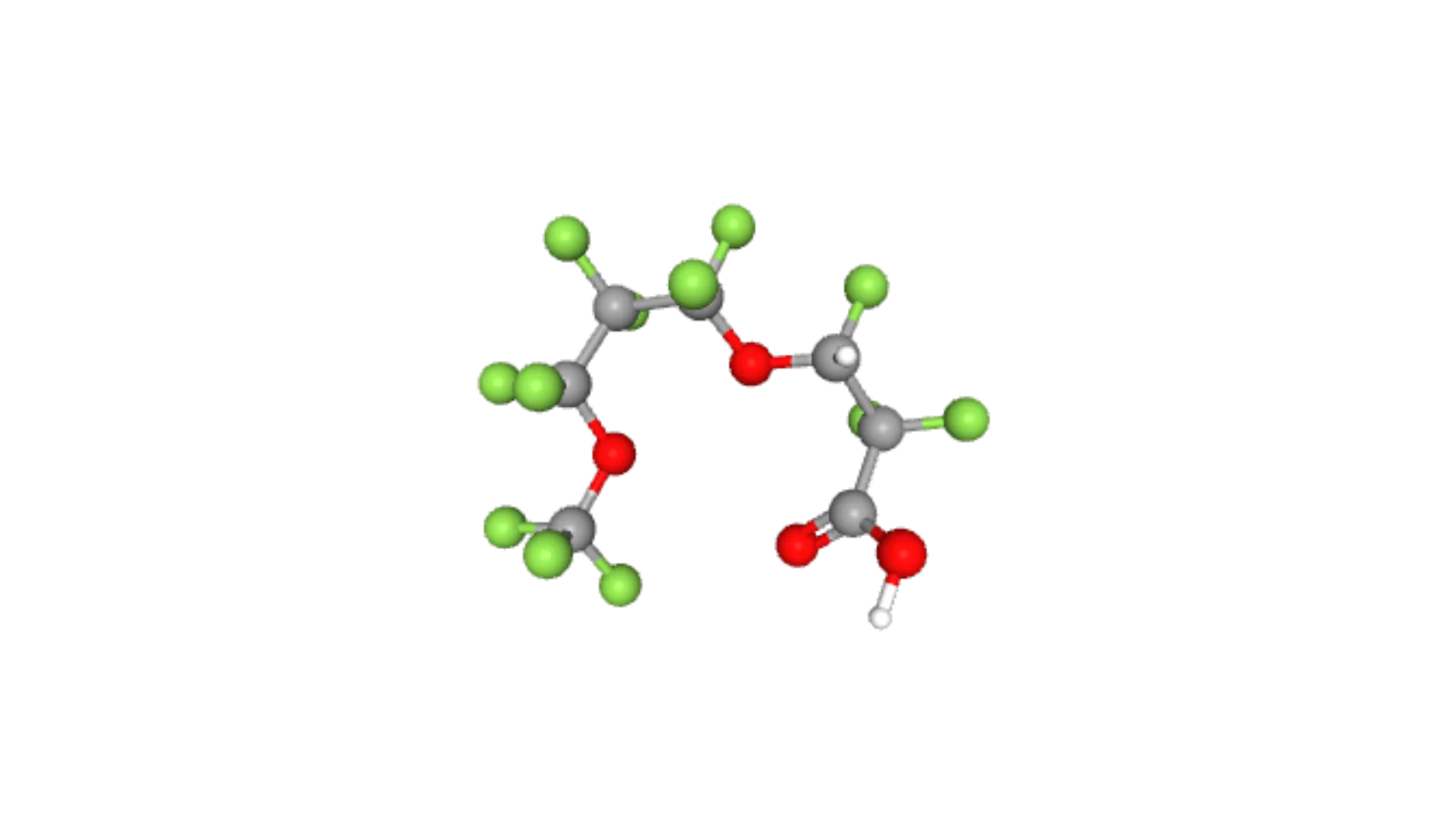
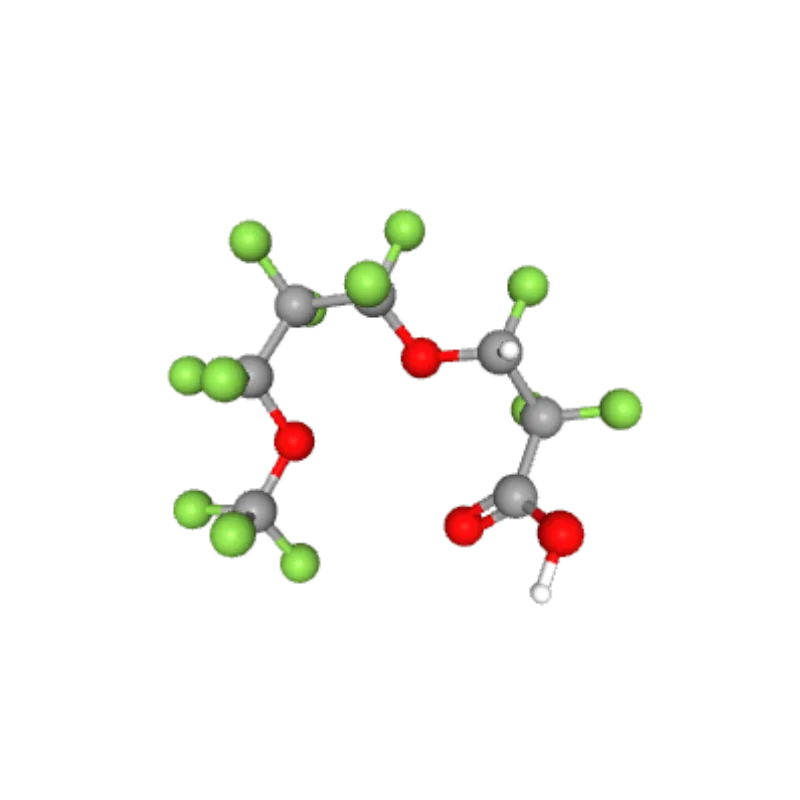
4,8-dioxa-3H-perfluorononanoic acid
2,2,3-trifluoro-3-[1,1,2,2,3,3-hexafluoro-3-(trifluoromethoxy)propoxy]propanoic acid
A perfluoroether carboxylic acid developed by 3M/Dyneon as a PFOA replacement for fluoropolymer manufacturing. Persistent in the environment; detected at low ppt levels in U.S. drinking water under EPA's UCMR 5 monitoring program.
Primary concern: Immune and liver toxicity
Affected organ systems
Health effects
Exposure routes
Vulnerable populations
Overview
4,8-Dioxa-3H-perfluorononanoic acid (ADONA), commonly sold under the trade name ADONA as its ammonium salt, is a short-to-medium-chain perfluoroether carboxylic acid. It was introduced by 3M and its German subsidiary Dyneon around 2008 as a 'next-generation' processing aid for fluoropolymer manufacturing (PTFE, PFA, FEP), intended as a replacement for PFOA after the EPA's 2010/2015 PFOA Stewardship Program. Like the closely related Chemours product GenX (HFPO-DA), ADONA was marketed as having a shorter half-life in humans than legacy long-chain PFAS — but it shares the same extreme environmental persistence and has now been detected in 55 U.S. public water systems serving roughly 712,000 people under EPA's UCMR 5 monitoring program.
Pollution sources
Sources
ADONA enters drinking water primarily through industrial discharges from fluoropolymer manufacturing plants. The principal known source is Dyneon's Gendorf facility in Bavaria, Germany, where ADONA has been used since 2008; in the United States, smaller-scale use and atmospheric long-range transport account for most documented occurrence. UCMR 5 detections so far cluster in New York, California, Texas, Alabama, and the Northeast, with the highest reported level (18.8 ppt) at a small mobile-home park in Selkirk, NY. As with other perfluoroether acids, ADONA is highly mobile in groundwater, resists degradation indefinitely, and does not partition strongly into soil or sediment.
Health risks
ADONA has not been formally classified as a carcinogen by IARC or NTP, and its toxicological dataset is smaller than that of PFOA or PFOS. Animal studies have nonetheless reported hepatotoxicity, thyroid effects, and developmental impacts at oral doses in the same range as other PFAS of concern. Manufacturer-funded biomonitoring of workers at Dyneon's Gendorf plant reported a human serum elimination half-life on the order of weeks-to-months — much shorter than PFOA (~2.4 years) — but independent verification is limited, and the underlying environmental persistence is unchanged. ADONA is monitored under UCMR 5 but is not currently subject to a federal MCL.
Effective treatments
Does not remove
NSF certifications
Water treatment
ADONA is removed effectively by granular activated carbon (GAC), anion exchange resin, and high-pressure membranes including reverse osmosis and nanofiltration. Because ADONA is a shorter-chain perfluoroether acid, it adsorbs less strongly to GAC than long-chain PFAS such as PFOA — GAC breakthrough occurs sooner, so treatment plants must monitor and replace media more frequently. Conventional treatment processes — coagulation, sand filtration, disinfection, UV, and ozonation — do not remove it. Boiling concentrates rather than removes it. NSF/ANSI 53 and NSF P473 certify point-of-use filters for PFAS reduction; NSF/ANSI 58 covers RO systems.
Gallery
Related contaminants
Chemistry + classification data sourced from public databases (PubChem, EPA CompTox, IARC monographs); 3D molecular models from 3d.nih.gov where available.