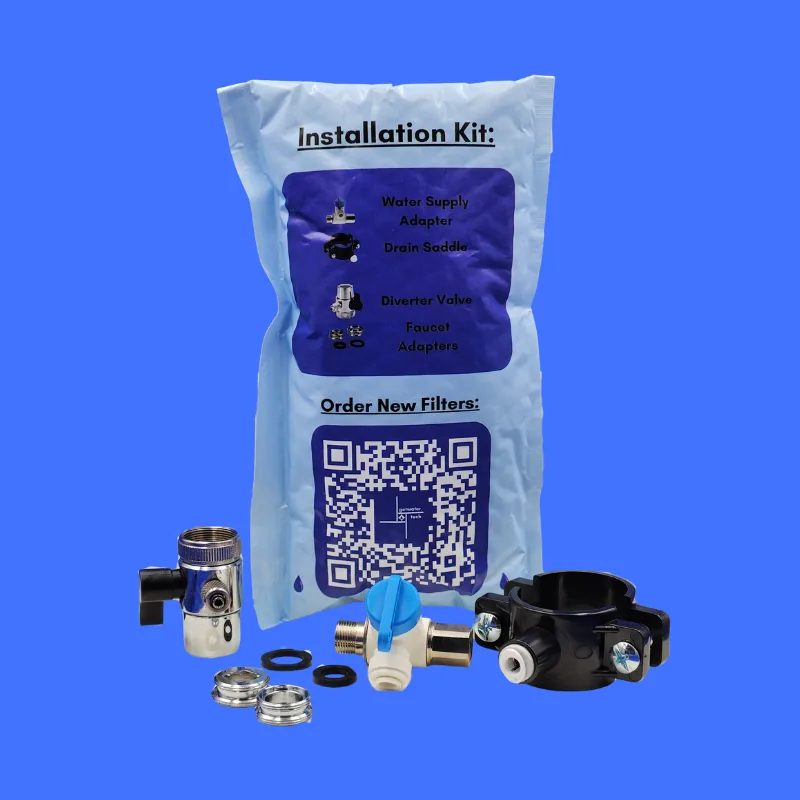
Under-Sink Kit
Coming soon — automated under-sink water production that keeps fresh RO water on tap.
Highlights
- Automated RO water production, on tap under your sink — coming soon.
Details
Coming soon: an automated under-sink system that produces and stores reverse-osmosis water, so you always have fresh water on tap. Full details to follow.
Reviews
No reviews yet.
See all reviews →What's really in your water?
The EPA required testing for these chemicals — but isn't enforcing limits until 2029
PFAS — synthetic "forever chemicals" linked to cancer, immune suppression, and developmental harm — have turned up in tap water across the country. A quality filter is the one thing you can control today.
67 million
Americans drink PFAS-contaminated water above the EPA's limit.
Of 10,299 systems tested, 1 in 7 are over.
4 ng/L
The EPA's legal limit for PFOA.
A 'non-detect' just means a result below 4 ng/L — not zero. More sensitive lab tests can measure lower.
363 utilities
Are actively treating for PFAS today.
The EPA gives the rest of the utilities until 2029 to implement a purification strategy.
Questions, answered
What contaminants do our water systems remove?
Our water systems are engineered to significantly reduce or eliminate a wide range of contaminants, providing you with cleaner, safer water.
Sediment filters: designed to remove sediment, dirt, rust, sand, and other particulate matter from the water. They improve water clarity and protect downstream filters, such as carbon filters and RO membranes, from premature clogging.
Carbon filters: effectively remove chlorine, chloramine, volatile organic compounds (VOCs), pesticides, herbicides, and other chemicals that can affect taste and odor.
Reverse-osmosis (RO) membranes: highly effective at removing a broad spectrum of contaminants, including lead, arsenic, fluoride, heavy metals, bacteria, viruses, cysts, and PFAS.
How often do I need to replace the filters/membrane?
Filter replacement frequency depends on your water usage and local water quality. Maintaining optimal water quality requires replacing filters regularly. Typically, we recommend these general guidelines:
Pre-filters: every 3–6 months. These filters handle the initial removal of larger particles and chlorine, protecting your RO membrane.
RO membrane: every 12 months. Keeping your membrane in great condition is critical to obtaining high-quality pure water.
Your actual replacement schedule may vary based on your water usage and the specific quality of your local water supply. We strongly recommend regular water testing to confirm your water quality and fine-tune your filter replacement schedule for peak performance.
How do I install my water system?
Each water system comes with a detailed installation manual. We also offer links to online video tutorials to assist with the install. Customer support is available to help guide you through the process if you would like to send us a message. If you're uncomfortable with small DIY installations, we recommend finding a professional installer in your area.
Do your water systems require any maintenance?
Beyond filter replacement, minimal maintenance is required. Periodically wipe down the exterior of the system and check for any leaks. Refer to your system manual for any specific maintenance instructions.
Where can I purchase replacement filters?
You can purchase replacement filters directly from our website, general retailers, or by contacting our customer service team. We recommend ordering replacement filters directly from us to ensure that you get the right replacement filter every time.
Can I return my water system?
Yes, you can return your water system if you are not satisfied. Due to the nature of the product, the water system must be unused and be returned within 30 days of purchase. Please refer to our Terms of Service policy for full details.
Get the full getwater.tech experience
Shop systems and filters, manage subscriptions, track orders, and check your water quality — all in the app.