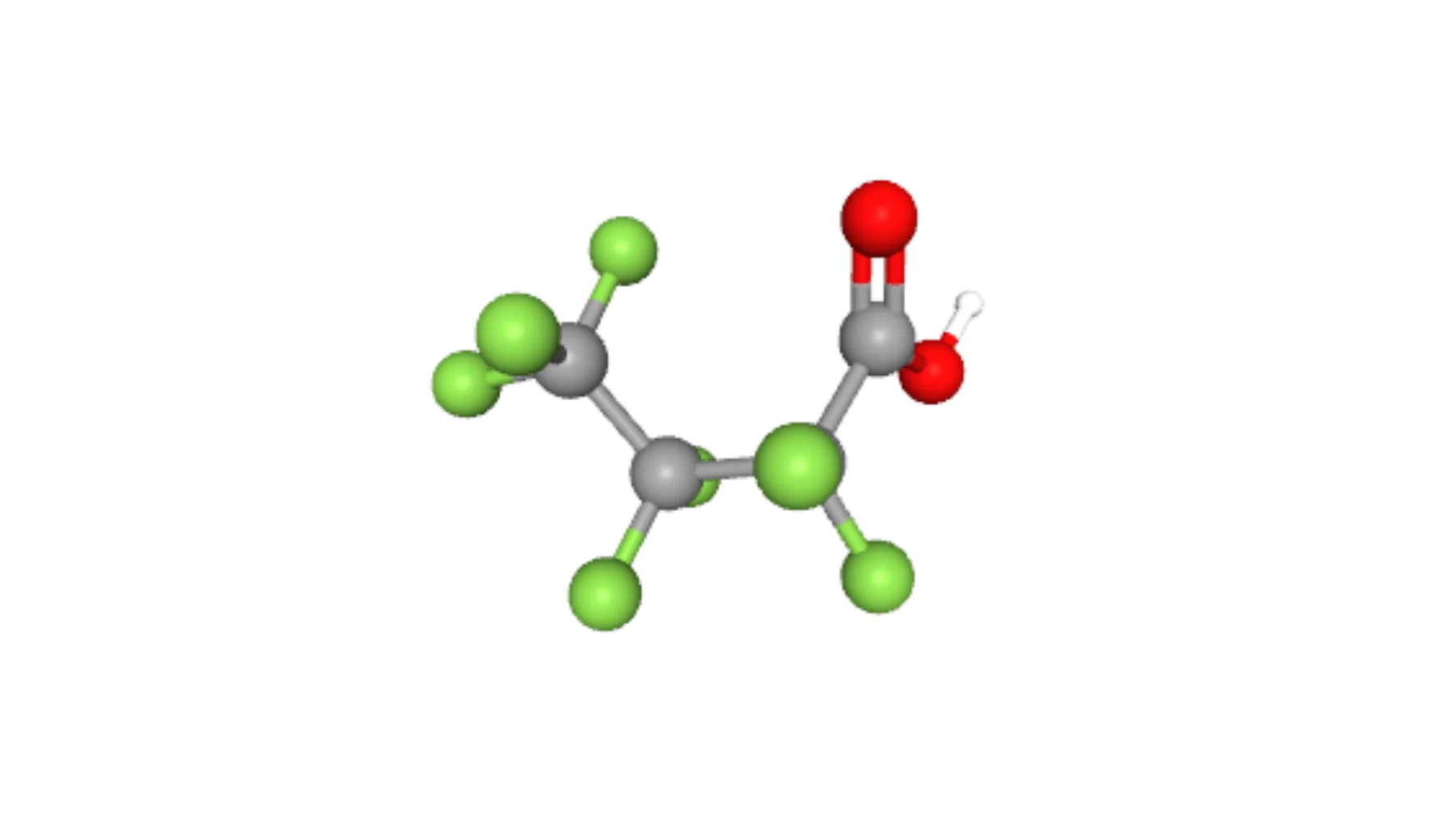
PFBA
Perfluorobutanoic Acid
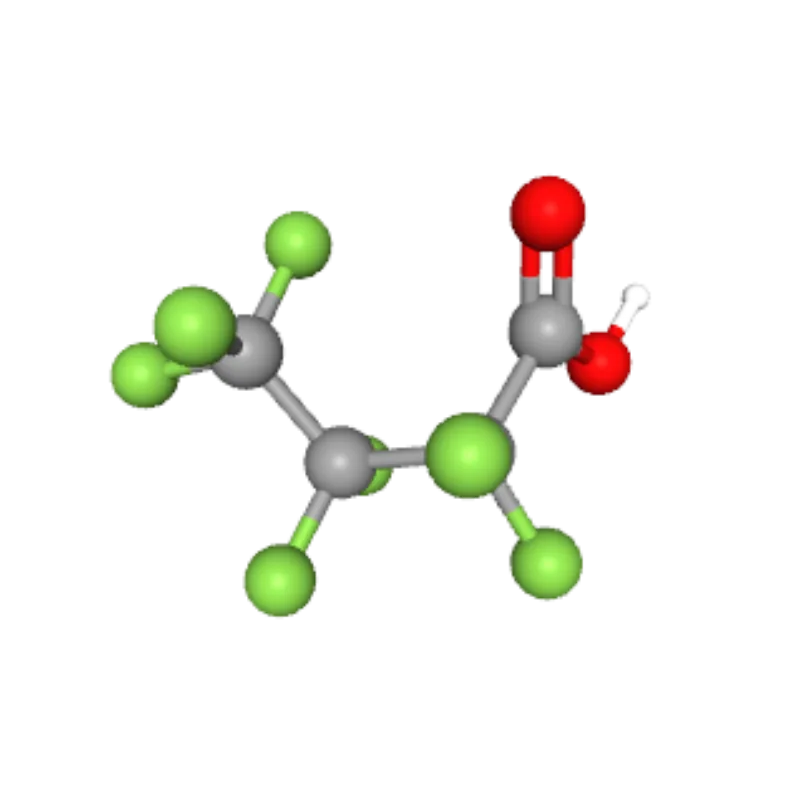
2,2,3,3,4,4,4-heptafluorobutanoic acid
A short-chain perfluorocarboxylic acid (PFCA) — among the most-detected PFAS in U.S. drinking water (3,427 utilities, 95M served). Less bioaccumulative than long-chain PFAS; no individual federal MCL.
Primary concern: Developmental effects
Affected organ systems
Health effects
Exposure routes
Vulnerable populations
Overview
Perfluorobutanoic acid (PFBA) is a four-carbon perfluoroalkyl carboxylic acid — the shortest member of the PFCA family monitored under UCMR 5. It rose to prominence after 2002, when major fluorochemical manufacturers began moving away from long-chain PFOA chemistry toward short-chain telomer products that were marketed as 'less bioaccumulative.' Two structural facts drive PFBA's drinking-water profile: (1) the short 4-carbon perfluoroalkyl chain gives the compound very high water solubility (about 5,000 mg/L), very low affinity for soils and granular activated carbon, and a much shorter human serum elimination half-life (~3 days) than the years-long retention seen for PFOA/PFOS; and (2) those same properties make PFBA highly mobile in groundwater — and as a result it is now the highest-occurrence PFAS in UCMR 5, detected in 3,427 U.S. public water systems serving roughly 95 million people across 46 states.
Pollution sources
Sources
The single largest documented U.S. source of PFBA is the legacy 3M manufacturing and disposal complex in Cottage Grove, Minnesota, where decades of fluorochemical production and downstream landfill disposal contaminated the Prairie du Chien-Jordan aquifer that supplies the Twin Cities east-metro suburbs. The result is a tightly clustered hot-spot: Oakdale (1,067 ppt — the plume's peak), Cottage Grove (672 ppt), Saint Paul Park (788 ppt), Woodbury (265 ppt), Hastings (254 ppt), and Stillwater (102 ppt) all sit on or near the plume. Outside Minnesota, PFBA appears as a low-ppt background almost nationwide, driven by (a) atmospheric deposition from fluoropolymer manufacturing, (b) environmental biotransformation of short-chain fluorotelomer precursors used in stain- and grease-resistant coatings on food packaging, textiles, and carpet, and (c) leachate from landfills receiving short-chain PFAS consumer products.
Health risks
PFBA's short biological half-life means it does not accumulate in human serum to the degree that long-chain PFAS do — but it is no less environmentally persistent, and high-dose animal studies have reported hepatic, thyroid, and developmental effects. EPA has not finalized a PFBA-specific Reference Dose; risk is class-extrapolated from EPA's IRIS Reference Dose for PFHxA (a structurally similar short-chain PFAS), with fetal growth and child development as the dose-defining endpoint. PFBA has not been classified as a carcinogen by IARC or NTP.
Effective treatments
Does not remove
NSF certifications
Water treatment
PFBA is the hardest of the UCMR 5 PFAS to remove with granular activated carbon: the short perfluorinated chain gives only weak hydrophobic interaction with GAC media, and bed breakthrough commonly occurs at a small fraction of the throughput volume needed to capture long-chain PFAS like PFOA or PFOS. Utilities targeting PFBA should plan on anion exchange resin (selective for short-chain PFAS), reverse osmosis, or nanofiltration as the primary barrier — with GAC used as a polishing or co-removal step for the broader PFAS mixture. Conventional treatment processes — coagulation, sand filtration, disinfection, UV, and ozonation — do not remove PFBA. Boiling concentrates rather than removes it. NSF/ANSI 53 and NSF P473 certify point-of-use filters for general PFAS reduction; NSF/ANSI 58 covers RO systems.
Gallery
Related contaminants
Chemistry + classification data sourced from public databases (PubChem, EPA CompTox, IARC monographs); 3D molecular models from 3d.nih.gov where available.