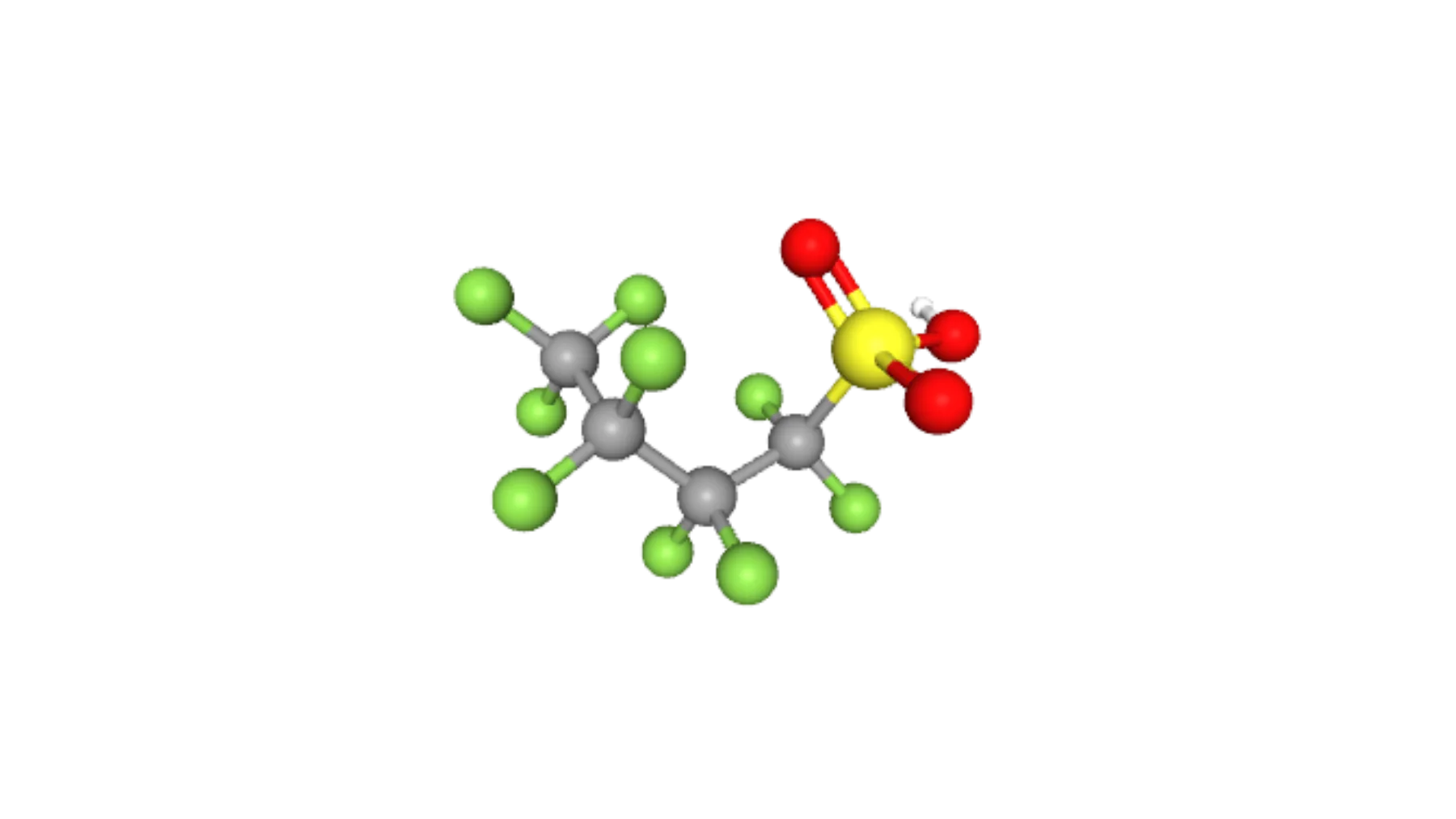
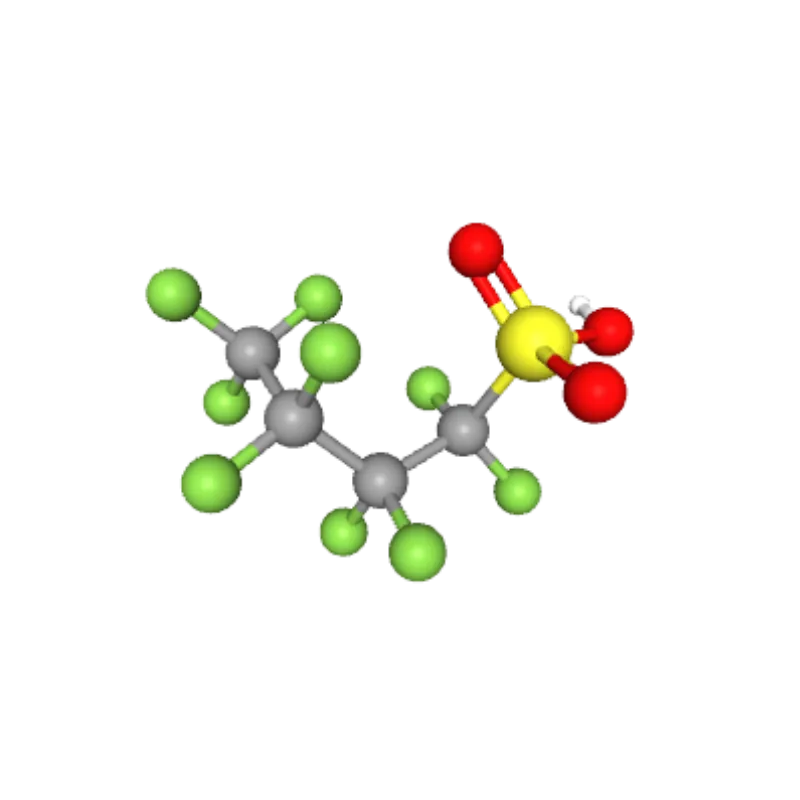
PFBS
Perfluorobutane sulfonate
1,1,2,2,3,3,4,4,4-nonafluorobutane-1-sulfonic acid
A short-chain perfluoroalkyl sulfonic acid (PFSA) — among the most-detected PFAS in U.S. drinking water (4,285 utilities, 99M served). 3M's chosen PFOS-replacement chemistry post-2002; regulated as part of the NPDWR Hazard Index mixture.
Primary concern: Hormone disruption and developmental effects
Affected organ systems
Health effects
Exposure routes
Vulnerable populations
Overview
Perfluorobutane sulfonate (PFBS) is the four-carbon perfluoroalkyl sulfonic acid — the short-chain sibling of PFOS, with the same sulfonate head group but only four perfluorinated carbons in the tail instead of eight. After 3M voluntarily phased out PFOS production in 2002, the company adopted PFBS as the lead replacement chemistry for its 'next-generation' Scotchgard line and broader sulfonamide-based stain, grease, and water repellents. The short chain gives PFBS very high water solubility, low affinity for soil and granular activated carbon, and a much shorter human serum elimination half-life (about 26 days; cf. ~5.4 years for PFOS) — but environmental persistence is essentially unchanged. The combination makes PFBS the second-highest-occurrence PFAS in UCMR 5: detected in 4,285 U.S. public water systems serving roughly 99 million people across 46 states.
Pollution sources
Sources
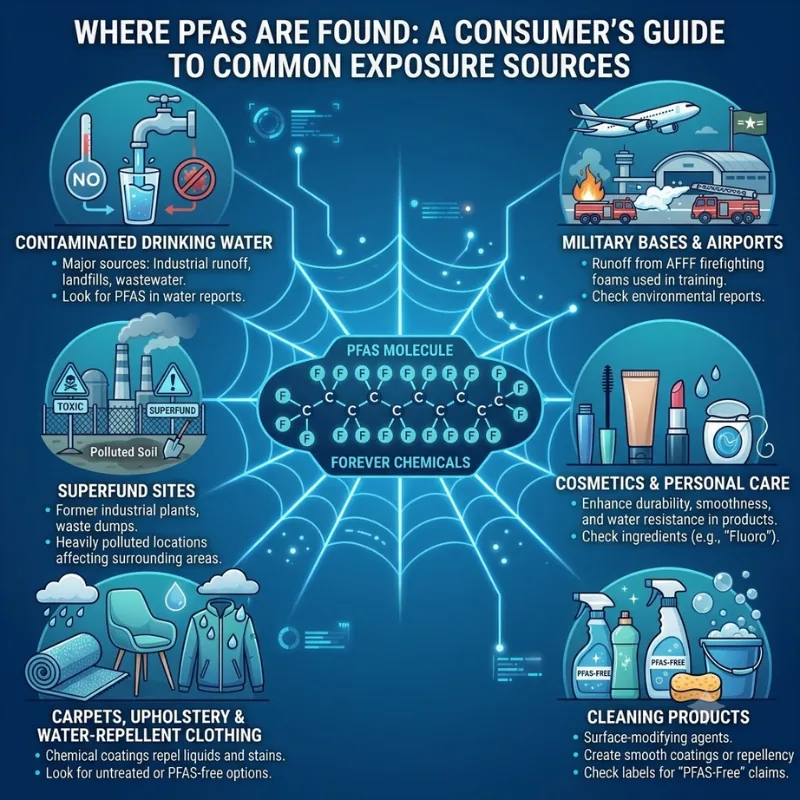
PFBS enters drinking water through three principal pathways: (1) direct industrial discharges and disposal-site leachate from former 3M production sites and downstream textile-, paper-, and carpet-treatment licensees — including the legacy 3M Cottage Grove, Minnesota complex, where post-PFOS PFBS chemistry produced a documented groundwater plume in the Twin Cities east metro; (2) AFFF firefighting-foam release sites and military airfields where PFBS appears as both a direct ingredient in newer-generation foams and as a degradation product of older perfluoroalkyl sulfonamide chemistries; and (3) environmental transformation of short-chain fluorotelomer sulfonates used in stain-resistant consumer coatings. The highest reported U.S. concentration is Rome, GA at 210 ppt (3 of 3 tests); the most striking chronic-source pattern is the Gadsden, AL water complex (40 of 41 tests positive at 84.5 ppt) — a clear localized industrial source.
Health risks
EPA finalized an Integrated Risk Information System (IRIS) toxicity assessment for PFBS in 2021, identifying neonatal thyroid hormone disruption (decreased serum T4 in newborn mice from gestational exposure) as the dose-defining endpoint. Thyroid hormone disruption and developmental effects on fetal growth and early childhood are the principal endpoints associated with that EPA reference dose. PFBS has not been classified as a carcinogen by IARC or NTP. Although PFBS does not have its own individual federal MCL under the 2024 PFAS NPDWR, it is one of four PFAS contributing to the Hazard Index mixture rule (alongside PFHxS, HFPO-DA, and PFNA) — meaning regulated utilities must include PFBS in the mixture calculation even though the analyte itself sits at the UCMR-monitoring tier of the schema.
Effective treatments
Does not remove
NSF certifications
Water treatment
Like its PFCA sibling PFBA, PFBS is one of the harder UCMR 5 PFAS to remove with granular activated carbon: the short perfluorinated chain gives only modest hydrophobic interaction with GAC media, and bed breakthrough occurs at a small fraction of the throughput needed for long-chain PFAS like PFOS. Utilities targeting PFBS should plan on anion exchange resin (selective for short-chain PFAS), reverse osmosis, or nanofiltration as the primary barrier — with GAC as a polishing or co-removal step for the broader PFAS mixture. Conventional treatment processes — coagulation, sand filtration, disinfection, UV, and ozonation — do not remove PFBS. Boiling concentrates rather than removes it. NSF/ANSI 53 and NSF P473 certify point-of-use filters for general PFAS reduction; NSF/ANSI 58 covers RO systems.
Gallery
Related contaminants
Chemistry + classification data sourced from public databases (PubChem, EPA CompTox, IARC monographs); 3D molecular models from 3d.nih.gov where available.