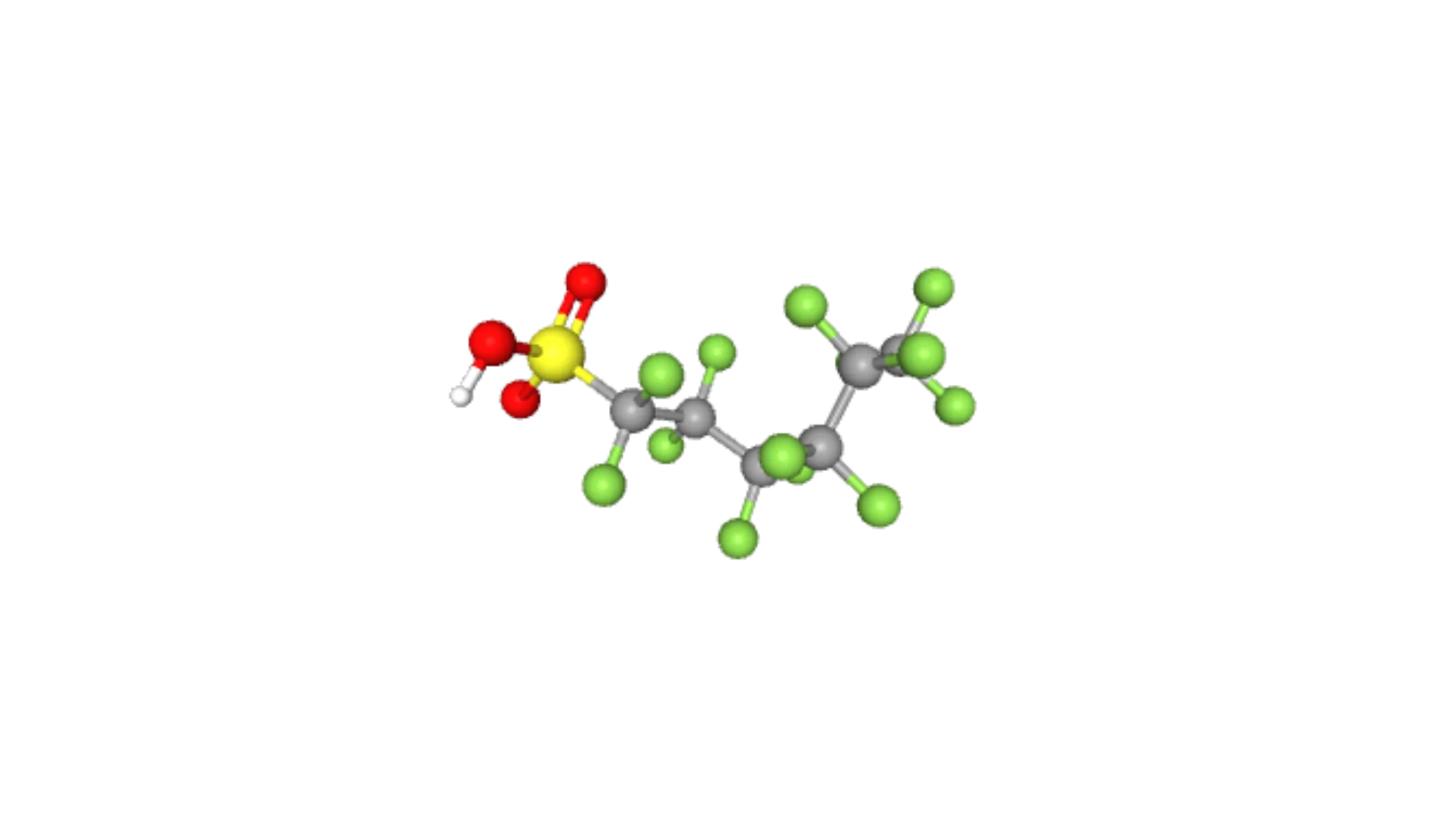
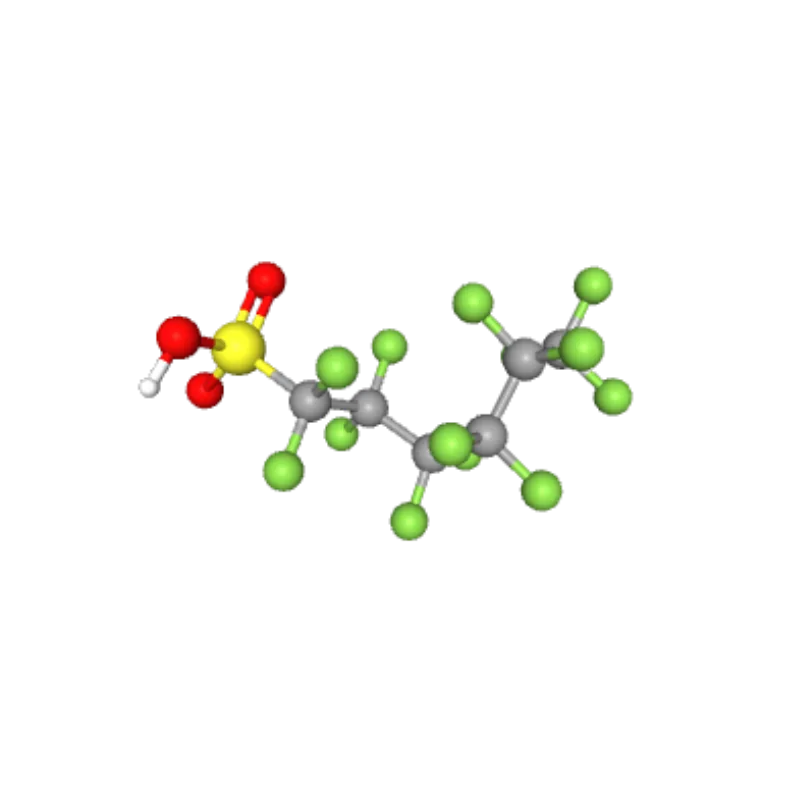
PFHxS
Perfluorohexane sulfonate
1,1,2,2,3,3,4,4,5,5,6,6,6-tridecafluorohexane-1-sulfonic acid
A 6-carbon long-chain PFSA with 2024 NPDWR individual MCL of 10 ppt. EPA's 2023 IRIS RfD targets developmental immune effects; detected at 3,144 utilities serving 71M people across 46 states.
Primary concern: Developing immune system and thyroid hormone (T4) effects
Affected organ systems
Health effects
Exposure routes
Vulnerable populations
Overview
Perfluorohexanesulfonic acid (PFHxS) is a 6-carbon perfluoroalkyl sulfonic acid (C6HF13O3S, MW 400) — the shortest-chain PFAS to receive an individual federal Maximum Contaminant Level under the 2024 NPDWR. EPA finalized the PFHxS IRIS toxicological review in 2023, identifying decreased serum free thyroxine (T4) and reduced antibody response to childhood vaccines as the dose-defining endpoints, and set the federal MCL at 10 parts per trillion with a matching MCLG of 10 ppt — the MCLG is not zero because IARC has not classified PFHxS as a Group 1 carcinogen, unlike PFOA and PFOS. PFHxS is also a regulated component of the NPDWR Hazard Index mixture alongside PFNA, HFPO-DA, and PFBS. Like PFOS, PFHxS persists indefinitely in the environment and bioaccumulates in human serum with one of the longest measured PFAS half-lives — published central values cluster around 8.5 years (Olsen 2007, 3M production-worker cohort). PFHxS appears in U.S. drinking water at 3,144 public water systems serving roughly 71 million people across 46 states; dozens of large municipal utilities measure at or above the 10 ppt federal MCL.
Pollution sources
Sources
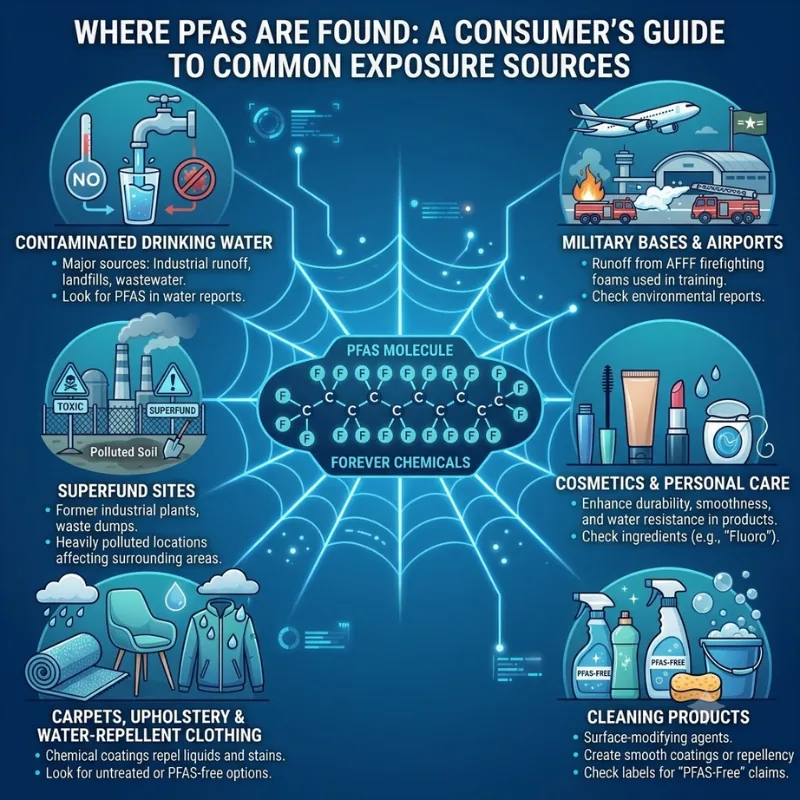
PFHxS reaches drinking water predominantly through three legacy pathways. (1) Aqueous film-forming foam (AFFF) release at military installations and civilian airports is the dominant signature — the PFHxS top-occurrence list reads like an AFB roster: Stratmoor Hills and Security Water District in Colorado Springs (155.5 and 132.0 ppt) sit downstream of the Peterson Space Force Base / former Peterson AFB AFFF impact area; Fort Campbell on the Kentucky/Tennessee line (30.1 ppt at both on-base and county-supply systems); Wright-Patterson AFB in Ohio (23.2 ppt across 22 of 22 tests); Camp Pendleton North in California (22.2 ppt, 156 of 162 tests); and Fort Riley, Kansas (18.8 ppt). (2) 3M-era PFOS-based Scotchgard manufacturing and use, of which PFHxS was a minor synthesis impurity and co-precursor — Bemidji, MN (84.2 ppt over 51 tests) sits within the Bemidji Regional Airport AFFF and 3M Cottage Grove regional influence area, and the Oakdale, MN system (10.6 ppt) traces directly to 3M Cottage Grove. (3) Industrial discharges from chrome plating, semiconductor fabrication, and other industries where PFHxS replaced PFOS as a mist suppressant in the mid-2000s — Hannah Heights HOA in Friday Harbor, WA (725.9 ppt average across 2 of 4 tests) and Oatman Water in Scottsdale, AZ (710.0 ppt) are the two highest PFHxS detections in the national occurrence dataset and reflect localized point-source impacts. Major municipal systems exceeding the 10 ppt federal MCL include the City of Greensboro, NC (11.1 ppt serving 318,057 people) and Fayetteville Public Works Commission, NC (10.7 ppt serving 214,137 people) — both within the Cape Fear basin Chemours influence area.
Health risks
EPA's 2023 IRIS toxicological review identifies two co-critical endpoints for PFHxS: decreased serum free thyroxine (T4) in adults and reduced antibody response to childhood vaccines (the immune-developmental endpoint). The chronic Reference Dose is 4×10⁻⁷ mg/kg/day — orders of magnitude lower than EPA's PFHxA RfD of 5×10⁻⁴ mg/kg/day, which is why the surrogate-derived health benchmarks for long-chain PFSAs sit in the single-digit-ppt range versus thousand-ppt for PFHxA. Commonly listed PFHxS health concerns are cancer, immune system damage, hormone disruption, harm to fetal growth and child development, and harm to the liver. PFHxS has not been formally classified as a carcinogen by IARC or NTP, which is why the federal MCLG is set at 10 ppt rather than zero — the MCLG-of-zero approach EPA used for PFOA and PFOS reflects their IARC Group 1 cancer classifications, and PFHxS does not yet share that designation. PFHxS bioaccumulates: serum elimination half-life in humans is among the longest of any PFAS measured, with Olsen 2007 reporting a median of 8.5 years (range roughly 3-30 years across the 3M production-worker cohort). Detectable PFHxS appears in essentially 100% of U.S. adults sampled by NHANES, and serum levels have declined more slowly than PFOS since the 2002 3M phaseout.
Effective treatments
Does not remove
NSF certifications
Water treatment
PFHxS responds well to the same treatment technologies used for PFOS and other long-chain PFSAs: granular activated carbon (GAC), anion exchange resin, and high-pressure membranes (reverse osmosis, nanofiltration). The sulfonate head group provides strong electrostatic affinity for anion exchange media, and the 6-carbon perfluorinated tail provides adequate hydrophobic adsorption onto GAC — PFHxS breakthrough on GAC occurs later than the short-chain PFCAs (PFBA, PFHxA) but earlier than PFOS, and design loading rates fall between those two reference points. Conventional treatment processes — coagulation, sand filtration, disinfection, UV, and ozonation — do not remove PFHxS. Boiling concentrates rather than removes it. NSF/ANSI 53 and NSF P473 certify point-of-use filters for general PFAS reduction; NSF/ANSI 58 covers RO systems. Utilities targeting the 10 ppt federal MCL with GAC, AIX, or RO will incidentally control PFHxS to well below the federal Hazard Index threshold and will simultaneously reduce the other long-chain PFSAs (PFOS, PFHpS) that share treatment behavior; the surrogate-derived 0.001-ppt health benchmark sits below analytical reporting limits and is not operationally verifiable.
Gallery
Related contaminants
Chemistry + classification data sourced from public databases (PubChem, EPA CompTox, IARC monographs); 3D molecular models from 3d.nih.gov where available.