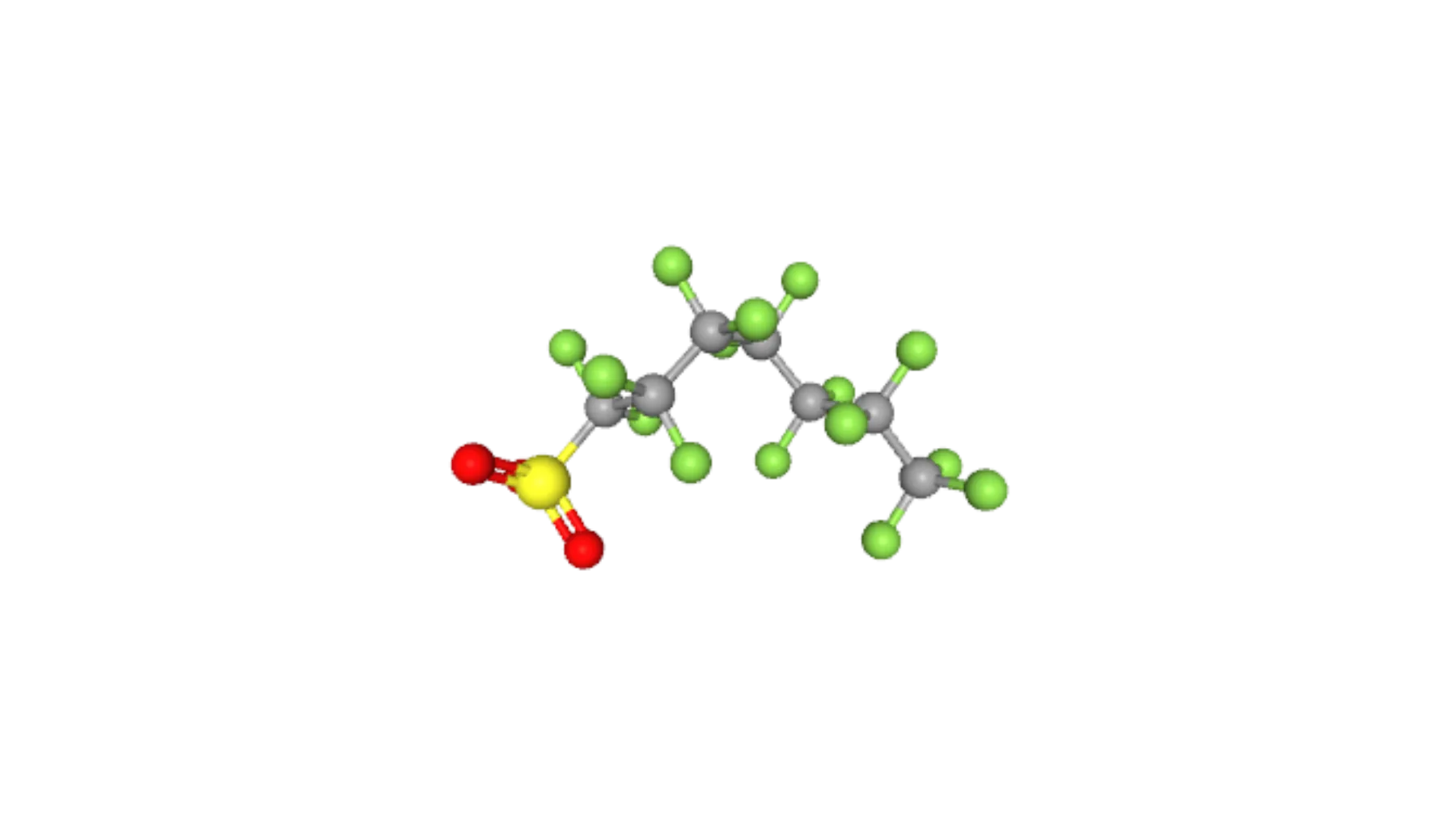
PFHpS
Perfluoroheptane sulfonic acid
1,1,2,2,3,3,4,4,5,5,6,6,7,7,7-pentadecafluoroheptane-1-sulfonic acid
A 7-carbon long-chain perfluoroalkyl sulfonic acid, one shorter than PFOS. Risk-assessed by surrogate to EPA's 2024 PFHxS IRIS toxicity value; detected at 70 utilities serving 1.3M people.
Primary concern: Developing immune system harm (PFHxS-surrogate)
Affected organ systems
Health effects
Exposure routes
Vulnerable populations
Overview
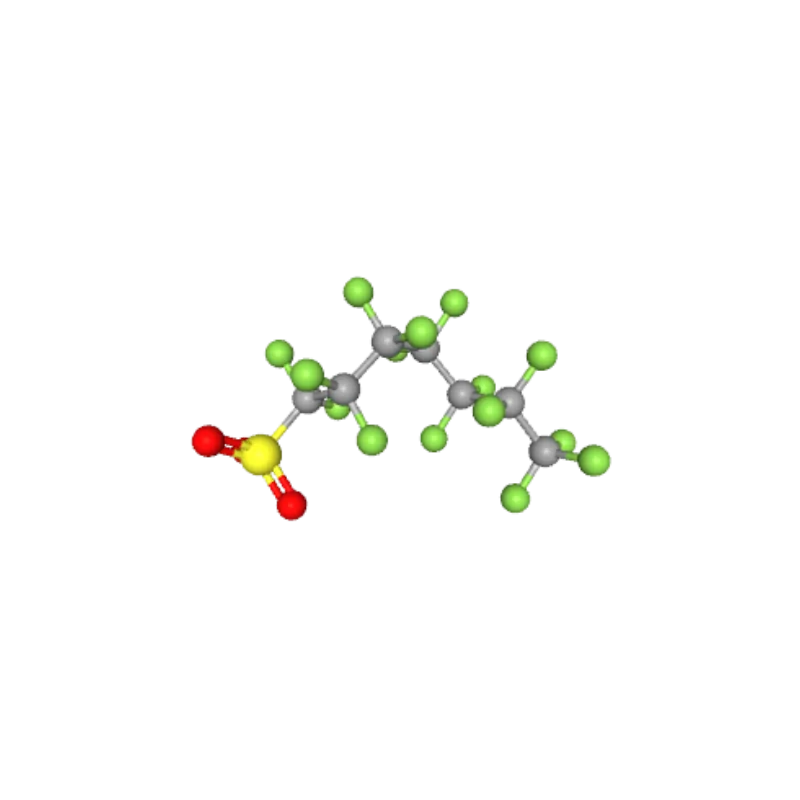
Perfluoroheptanesulfonic acid (PFHpS) is a 7-carbon perfluoroalkyl sulfonic acid (C7HF15O3S, MW 450) that sits structurally between PFHxS (6 carbons) and PFOS (8 carbons) — the two long-chain PFSAs that received individual federal MCLs of 10 ppt and 4 ppt respectively in the 2024 NPDWR. PFHpS is classified as long-chain by OECD's PFSA definition (≥6 carbons), and its perfluorinated backbone combined with the sulfonate head group gives it strong protein binding, low water solubility, and an expected multi-year human serum elimination half-life on par with PFHxS (~8 years) and PFOS (~5 years), though PFHpS-specific pharmacokinetic data in human cohorts is sparse and no defensible single half-life value is published. PFHpS is detected at 70 U.S. public water systems serving roughly 1.3 million people across 11 states. Risk is class-extrapolated from EPA's 2024 IRIS PFHxS toxicity value, yielding the most conservative health benchmark in the UCMR 5 analyte set. That benchmark sits well below analytical reporting limits, so every one of the 70 detecting utilities exceeds it.
Pollution sources
Sources
PFHpS in U.S. drinking water carries a strong aqueous film-forming foam (AFFF) fingerprint. Long-chain PFSAs — PFOS, PFHxS, and PFHpS — are characteristic of the legacy 3M-era PFOS-based AFFF formulations used at military installations and civilian airports from the 1970s through the early 2000s, and they appear together in groundwater at AFFF release sites. The UCMR 5 PFHpS top-occurrence list bears this signature out: Seymour Johnson Air Force Base in Goldsboro, NC (1.30 ppt) is a direct on-base detection, and the City of Goldsboro public system (1.30 ppt) is the off-base municipal water that draws from the same impacted aquifer; Hoosick Falls, NY (0.287 ppt over 69 tests) sits squarely on the well-documented Saint-Gobain / Honeywell PFOA-and-PFSA groundwater plume; Exeter Job Corps Center, RI (2.21 ppt over 15 tests) is on the former Navy Construction Battalion Center Davisville footprint; and the Nelliston / Fort Plain, NY pair share Mohawk Valley source water linked to historical industrial discharges. Secondary diffuse-background detections in California, Wisconsin, and Minnesota likely reflect a mix of fluorochemical-manufacturing legacy, AFFF-impacted aquifers, and biotransformation of PFOS-precursor surfactants used in historical stain- and water-resistant consumer-product coatings.
Health risks
EPA has not finalized a PFHpS-specific IRIS toxicological review or Reference Dose, and PFHpS does not have an individual federal MCL or appearance in the 2024 NPDWR Hazard Index mixture (the Hazard Index covers PFHxS, PFNA, PFBS, and HFPO-DA). Risk assessment uses the 2024 IRIS PFHxS toxicity value as a long-chain PFSA surrogate, on the basis that the two compounds share elimination behavior and likely similar developmental immune endpoints. Class-extrapolated endpoints commonly listed for PFHpS are cancer, immune system damage, hormone disruption, harm to fetal growth and child development, and harm to the liver — these come from broader PFAS-class evidence rather than a PFHpS-specific endpoint, and PFHpS has not been formally classified as a carcinogen by IARC or NTP. The regulatory gap matters operationally: utilities that meet the 10 ppt PFHxS individual MCL and the federal Hazard Index are not required to control PFHpS to any specific concentration, even though PFHpS arises from the same AFFF and fluorochemical-precursor sources.
Effective treatments
Does not remove
NSF certifications
Water treatment
PFHpS is one of the more straightforward UCMR 5 PFAS to remove because long-chain PFSAs adsorb very strongly onto granular activated carbon and anion exchange resin: the sulfonate head group provides electrostatic attraction to anion exchange media, and the 7-carbon perfluorinated tail provides hydrophobic affinity for GAC. PFHpS breakthrough on GAC typically occurs later than the shorter PFCAs (PFBA, PFHxA) and at concentrations close to PFOS and PFHxS performance. High-pressure membranes (reverse osmosis, nanofiltration) are also highly effective. Conventional treatment processes — coagulation, sand filtration, disinfection, UV, and ozonation — do not remove PFHpS. Boiling concentrates rather than removes it. NSF/ANSI 53 and NSF P473 certify point-of-use filters for general PFAS reduction; NSF/ANSI 58 covers RO systems. Because the surrogate-derived health benchmark sits below analytical reporting limits, no treatment process can be operationally verified to clear it — utilities sizing treatment for the 4 ppt PFOS / 10 ppt PFHxS NPDWR MCLs will incidentally control PFHpS to the same range at the same time.
Gallery
Related contaminants
Chemistry + classification data sourced from public databases (PubChem, EPA CompTox, IARC monographs); 3D molecular models from 3d.nih.gov where available.