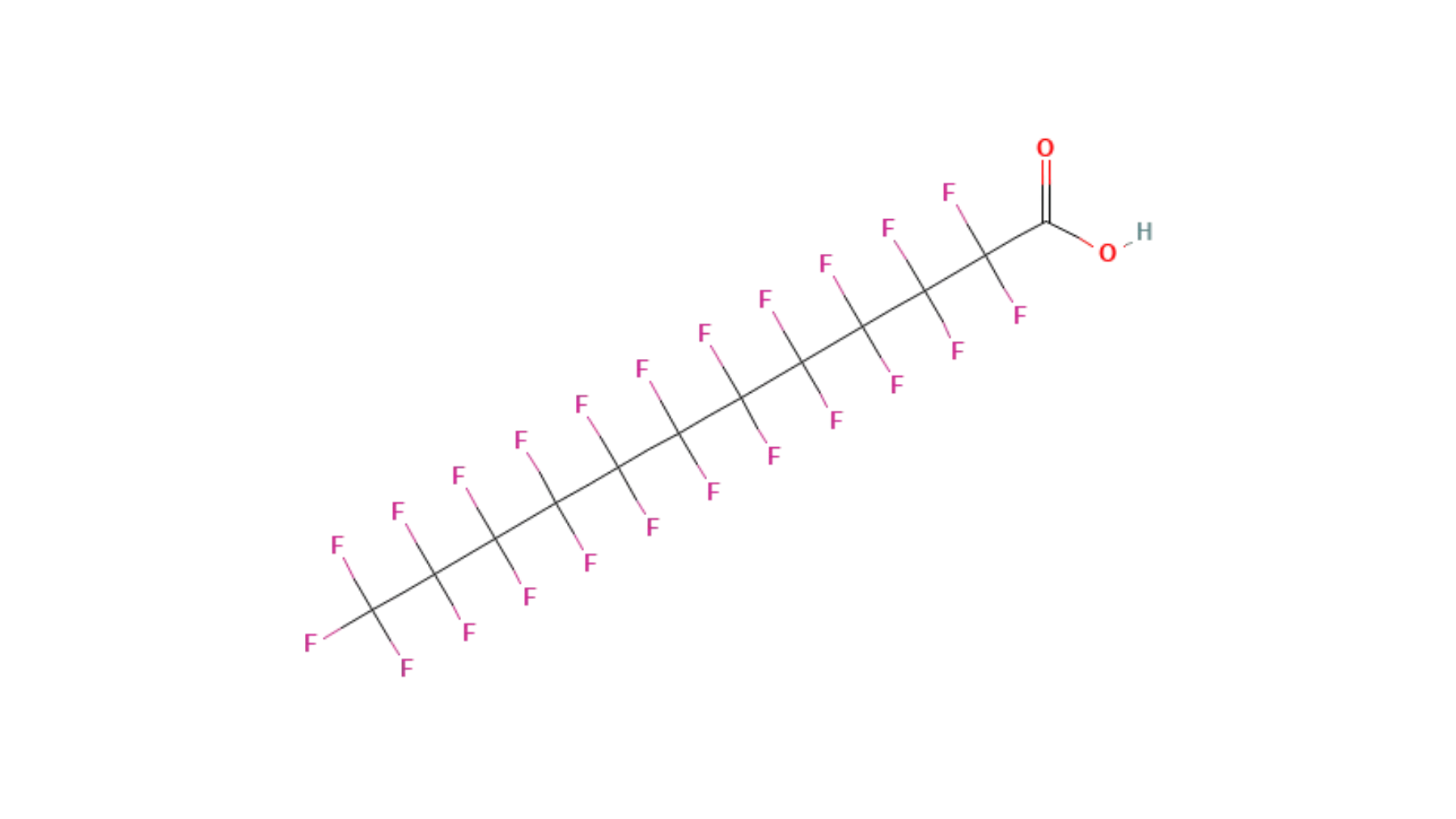
PFDoA
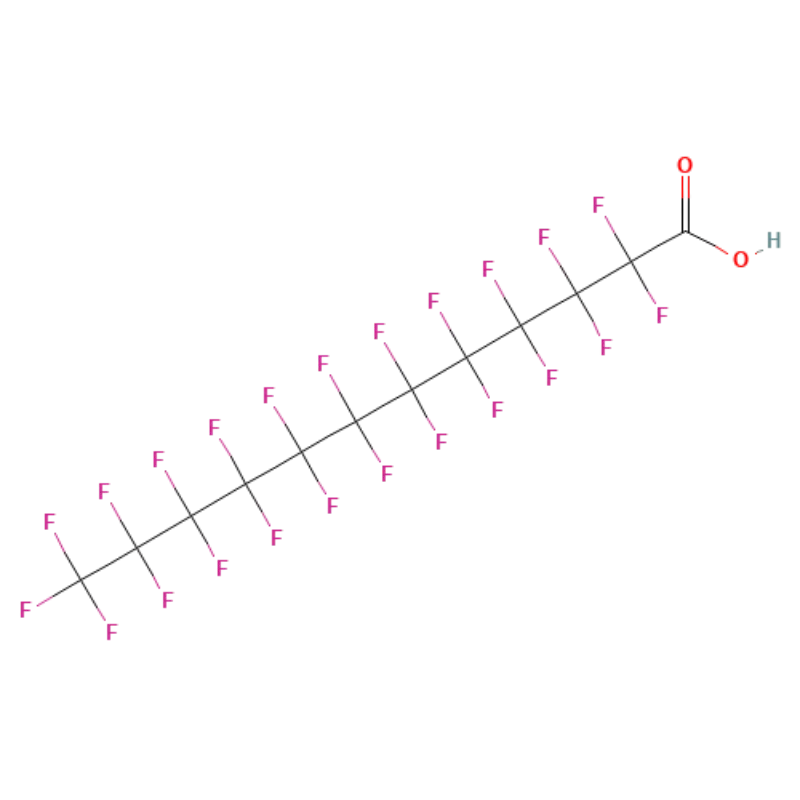
Perfluorododecanoic acid
2,2,3,3,4,4,5,5,6,6,7,7,8,8,9,9,10,10,11,11,12,12,12-tricosafluorododecanoic acid
A 12-carbon long-chain perfluorocarboxylic acid, more bioaccumulative than PFDA. Risk-assessed by surrogate to PFDA's 2024 IRIS RfD; detected in 93 U.S. public water systems serving 2.1M people under UCMR 5.
Primary concern: Immune and developmental effects
Affected organ systems
Health effects
Exposure routes
Vulnerable populations
Overview
Perfluorododecanoic acid (PFDoA) is a 12-carbon perfluoroalkyl carboxylic acid — two carbons longer than PFDA, four longer than PFOA, and at the upper end of the long-chain PFCA family monitored under UCMR 5. The longer perfluorinated chain pushes water solubility down to roughly 0.7 mg/L, drives strong protein binding in serum, and gives PFDoA a multi-year human elimination half-life on par with or longer than PFDA — published estimates span roughly 3 to 15 years depending on cohort, sex, and methodology, with central values commonly cited in the 5–10 year range. PFDoA has been detected in 93 U.S. public water systems serving roughly 2.1 million people across 11 states. Risk is class-extrapolated from PFDA's 2024 EPA IRIS reference dose on the basis of structural similarity and shared toxicological endpoints.
Pollution sources
Sources
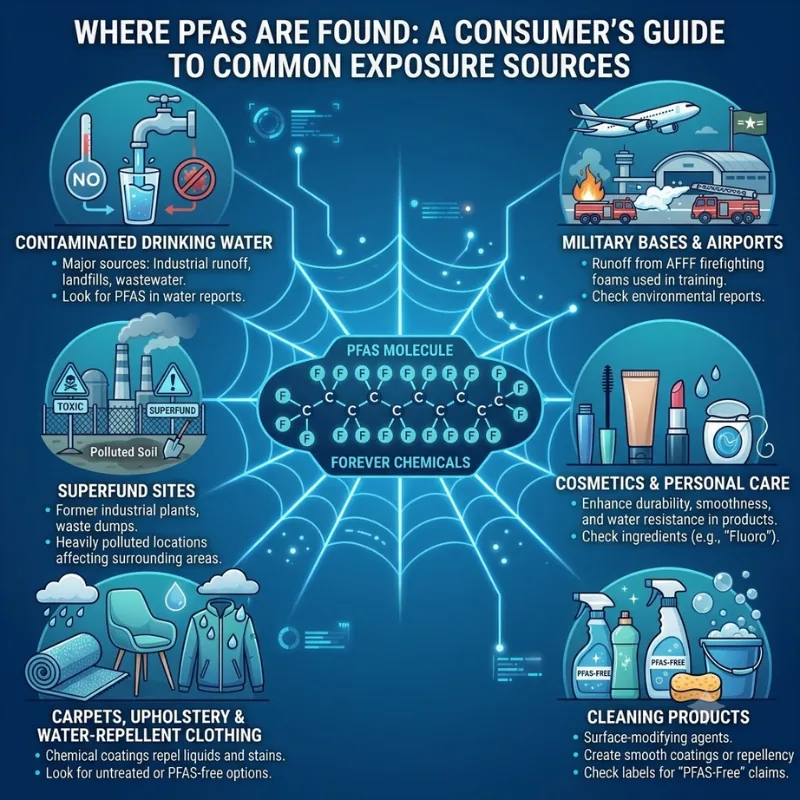
PFDoA enters drinking water through the same channels as other long-chain PFCAs: industrial discharges and atmospheric deposition from fluoropolymer manufacturing, AFFF firefighting-foam release sites, and environmental biotransformation of long-chain fluorotelomer precursors used in stain-, grease-, and water-resistant consumer coatings on textiles, paper, and food packaging. The UCMR 5 PFDoA detection footprint shows three notable patterns: (1) a North Carolina cluster (14 utilities) that mirrors the PFDA / HFPO-DA Chemours-Fayetteville-Works fingerprint along the Cape Fear River basin; (2) a tight Moncks Corner / Summerville, SC cluster all reporting 4.50 ppt, indicating a shared source-water blend; and (3) a chronic-source signature at Ann Arbor, MI (8 of 65 tests positive at 0.892 ppt) and Hoosick Falls, NY (11 of 71 positive at 0.269 ppt — the latter co-locating with the well-documented Saint-Gobain PFOA groundwater plume).
Health risks
PFDoA does not have its own EPA Reference Dose or IRIS toxicological review — the 2024 PFDA IRIS RfD applies as a class surrogate, supported by structural similarity (one repeat -CF2- unit longer) and similar toxicological endpoints in animal studies: hepatotoxicity, immune suppression, thyroid disruption, and adverse developmental effects. PFDoA has not been classified as a carcinogen by IARC or NTP, but cancer is commonly listed as a class-extrapolated concern alongside the four endpoints from the PFDA framework. Pharmacokinetic data in humans is limited; published serum half-life estimates span 3–15 years across small cohorts, and the wider range vs PFDA reflects the smaller, less-controlled dataset rather than a known biological difference. As with PFDA, the IRIS-derived health benchmark sits below typical analytical reporting limits, so nearly every detection exceeds it (89 of 93).
Effective treatments
Does not remove
NSF certifications
Water treatment
PFDoA's long perfluorinated chain makes it one of the easiest UCMR 5 PFAS to remove with granular activated carbon: long-chain PFCAs adsorb very strongly onto GAC media and break through later than long-chain PFSAs of comparable carbon number. Anion exchange resin and high-pressure membranes (reverse osmosis, nanofiltration) are also highly effective. Conventional treatment processes — coagulation, sand filtration, disinfection, UV, and ozonation — do not remove PFDoA. Boiling concentrates rather than removes it. NSF/ANSI 53 and NSF P473 certify point-of-use filters for general PFAS reduction; NSF/ANSI 58 covers RO systems. As with PFDA, the IRIS-derived health benchmark sits below analytical reporting limits, so 'compliance' with that benchmark is not a meaningful operational target — utilities should plan against the federal Hazard Index calculation (which does not include PFDoA today) and against the long-chain PFCA family-level reduction that comes free with a properly sized GAC or anion exchange train.
Gallery
Related contaminants
Chemistry + classification data sourced from public databases (PubChem, EPA CompTox, IARC monographs); 3D molecular models from 3d.nih.gov where available.