PFEESA
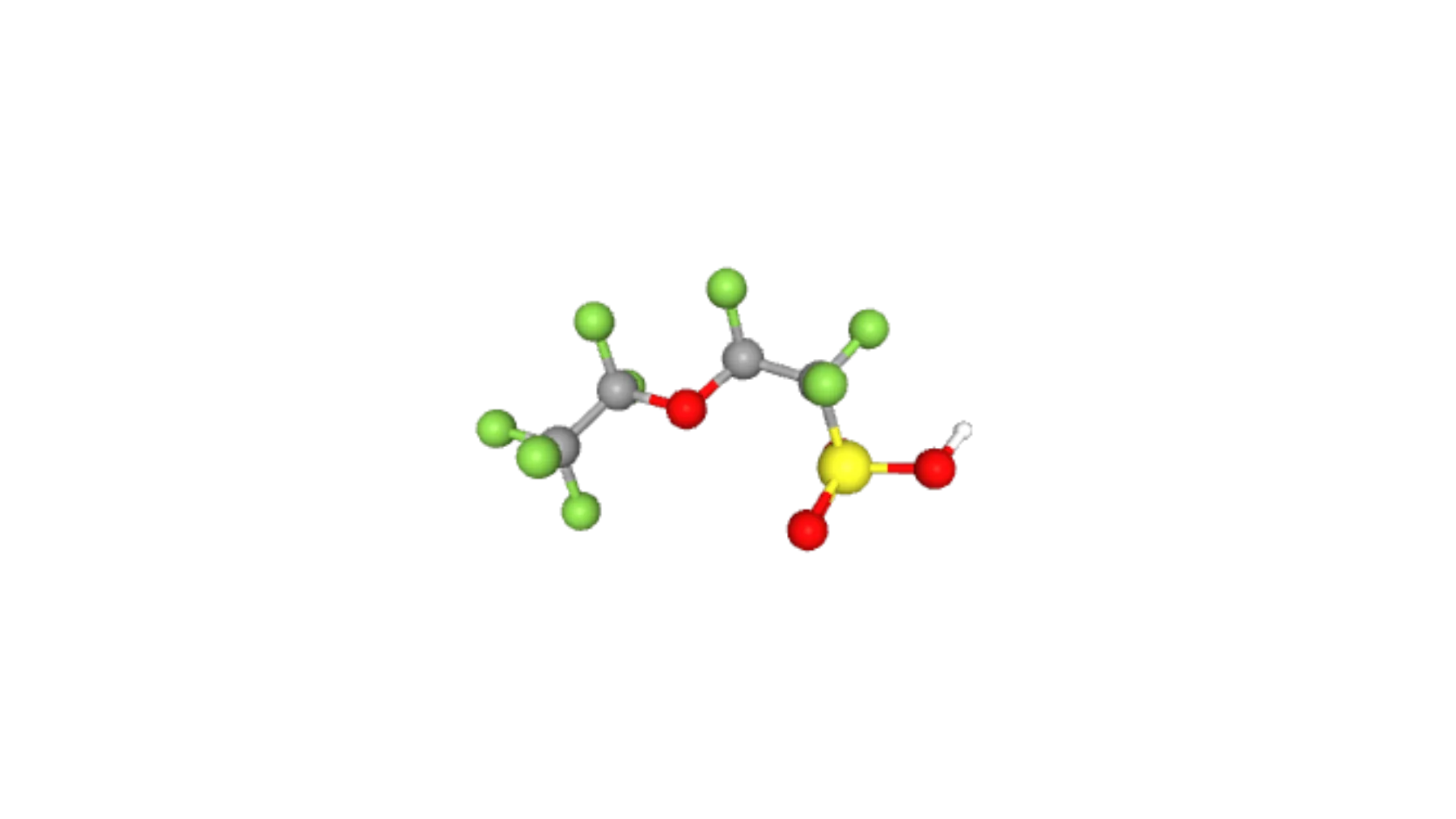
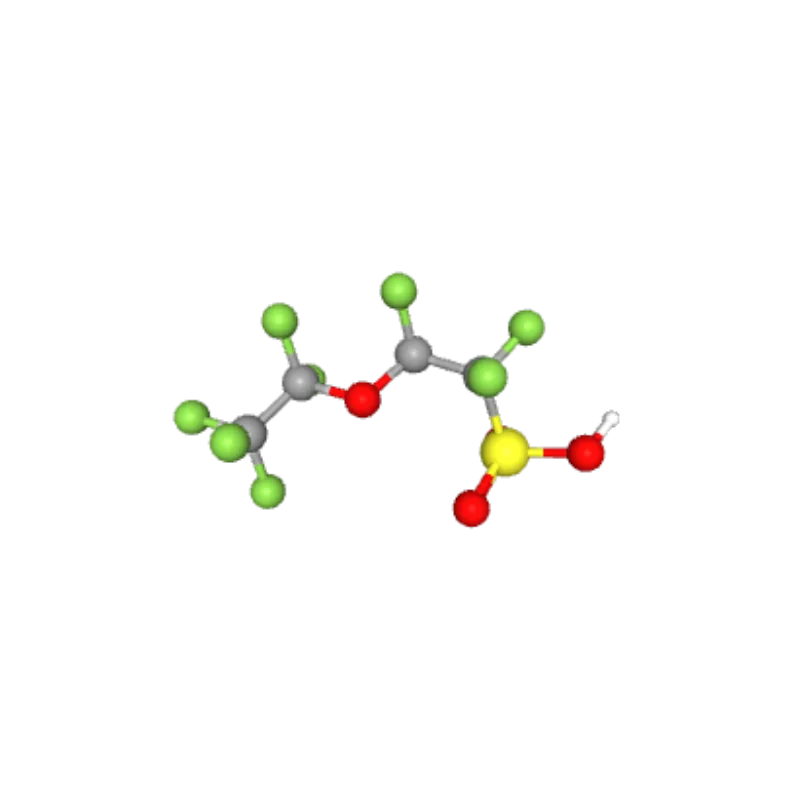
Perfluoro(2-ethoxyethane)sulfonic acid
1,1,2,2-tetrafluoro-2-(1,1,2,2,2-pentafluoroethoxy)ethanesulfonic acid
Short-chain perfluoroether sulfonic acid (C2-O-C2 sulfonate, MW 316). Toxicology dataset is thin; risk is class-extrapolated from PFAS. Lowest-occurrence UCMR 5 analyte — only 3 small NY utilities serving 1,140 people detected.
Primary concern: Class-extrapolated PFAS effects (limited individual toxicology)
Affected organ systems
Health effects
Exposure routes
Vulnerable populations
Overview
Perfluoro(2-ethoxyethane)sulfonic acid (PFEESA) is a short-chain perfluoroether sulfonic acid built from two perfluorinated -CF2CF2- units bridged by an ether oxygen and terminated by a sulfonate group (C4HF9O4S, MW 316). Structurally it sits in the same family as UCMR 5's two chlorinated perfluoroether sulfonic acids — 11Cl-PF3OUdS and 9Cl-PF3ONS (the components of F-53B) — but without their terminal chlorine and at a much shorter chain length, and on the PFSA side of the same chemistry that produces the PFCA-side perfluoroether NFDHA. PFEESA has the lowest occurrence of any PFAS in UCMR 5: it was detected at only three public water systems — all small Hudson Valley utilities in Columbia County, New York — serving a combined 1,140 people, with the highest reported average level of 0.950 ppt at Bells Pond Mobile Park North and the other two utilities at 0.232 and 0.243 ppt. The UCMR 5 Minimum Reporting Level for PFEESA is 3 ppt (0.003 µg/L), notably lower than NFDHA's 20 ppt MRL, which means low-ppt detections are reportable as genuine quantitations rather than estimated J-flagged values.
Pollution sources
Sources
Documented sources of PFEESA in U.S. drinking water are limited because the occurrence dataset is so small. PFEESA is not a high-volume commercial fluorochemical in its own right; it is most often discussed as a transformation product of larger perfluoroether sulfonate precursors and as a fluorochemical manufacturing-process intermediate. The three Columbia County, NY detections cluster geographically (Hudson, Thomaston, Copake — all within roughly 15 miles of one another), suggesting a shared regional groundwater source rather than three independent industrial releases; the Hudson Valley sits east of the Saint-Gobain / Honeywell PFAS plume centered on Hoosick Falls, NY, and the broader region has documented multi-PFAS groundwater impacts. With only three detections in the entire national UCMR 5 dataset, source attribution should be treated as preliminary — EPA included PFEESA in UCMR 5 precisely to build the occurrence dataset that source-identification work will need.
Health risks
There is no PFEESA-specific Reference Dose, Health Reference Level, or carcinogen classification from EPA, IARC, or NTP. PFEESA is not included in the 2024 NPDWR Hazard Index mixture (the four short-chain PFAS in that mixture are PFHxS, PFNA, HFPO-DA, and PFBS), and there is no individual MCL. Risk assessment is therefore class-extrapolated from the better-studied perfluoroalkyl sulfonic acids (PFOS, PFHxS, PFBS) and broader PFAS: the perfluorinated carbon-fluorine backbone and sulfonate head group are environmentally persistent and biologically mobile, and the structural family is consistently associated with hepatic, immune, and endocrine effects at sufficient exposure. Human pharmacokinetic data for PFEESA is essentially absent — no defensible serum half-life has been published. The very low measured concentrations (well under 1 ppt) at all three detecting utilities mean that, even under conservative class-extrapolated benchmarks, current exposure levels are low.
Effective treatments
Does not remove
NSF certifications
Water treatment
PFEESA is removed by the same processes that handle other short-chain perfluoroether acids: granular activated carbon (GAC), anion exchange resin, and high-pressure membranes (reverse osmosis, nanofiltration). The short perfluorinated chain and the sulfonate head group together favor anion exchange and RO over GAC — short-chain PFSAs typically break through GAC earlier than long-chain PFSAs of comparable carbon count, mirroring the operational pattern observed with PFBS. Conventional treatment processes — coagulation, sand filtration, disinfection, UV, and ozonation — do not remove PFEESA. Boiling concentrates rather than removes it. NSF/ANSI 53 and NSF P473 certify point-of-use filters for general PFAS reduction; NSF/ANSI 58 covers RO systems. Because PFEESA is not in the federal NPDWR Hazard Index and is detected at very low concentrations at only three small NY utilities, dedicated treatment for PFEESA is not a practical compliance target; utilities meeting the NPDWR Hazard Index and individual PFOA/PFOS/PFHxS/HFPO-DA/PFNA MCLs with GAC, AIX, or RO will incidentally control PFEESA at the same time.
Gallery
Related contaminants
Chemistry + classification data sourced from public databases (PubChem, EPA CompTox, IARC monographs); 3D molecular models from 3d.nih.gov where available.