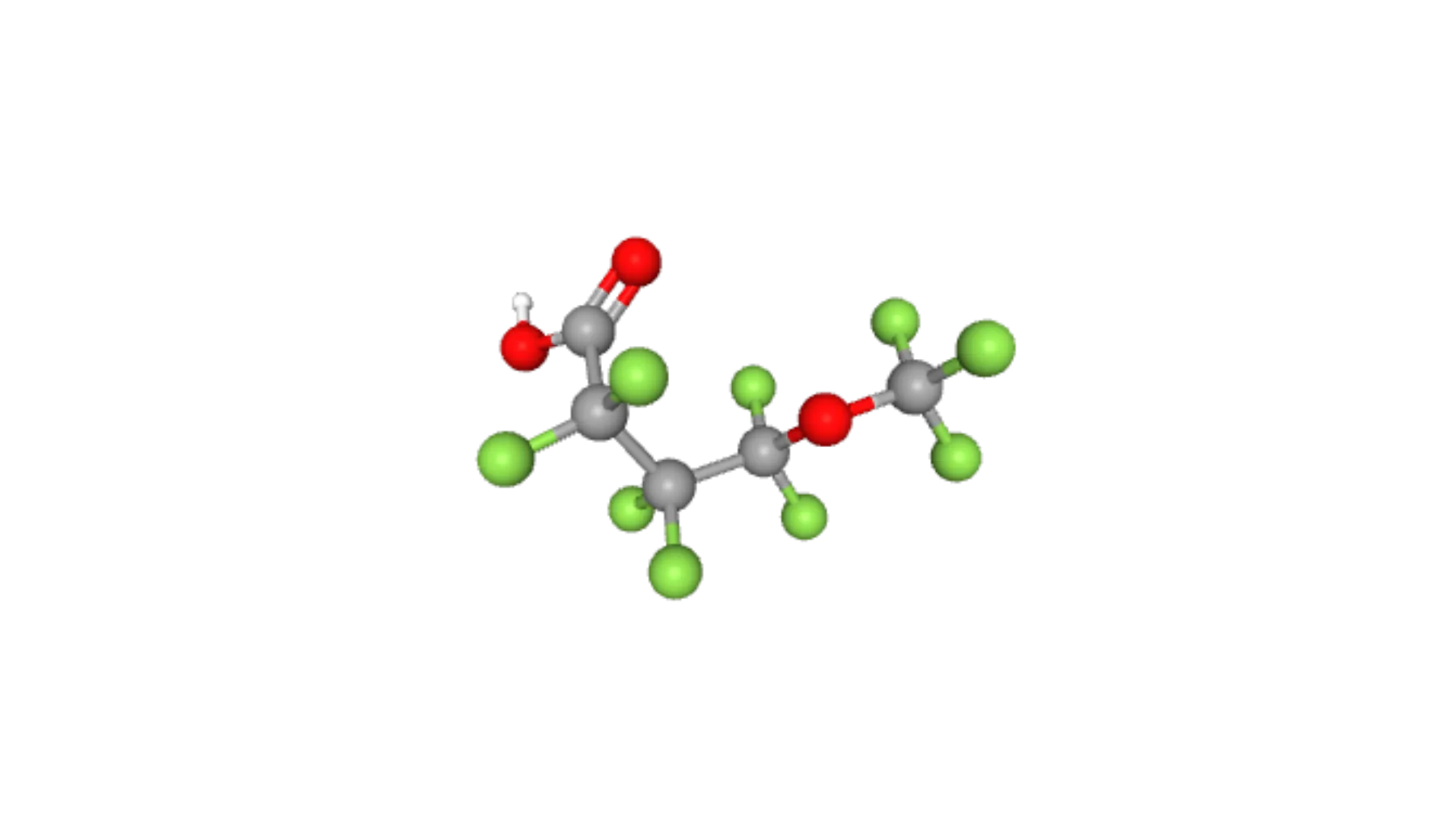
PFMBA
Butanoic acid, 2,2,3,3,4,4-hexafluoro-4-(trifluoro...
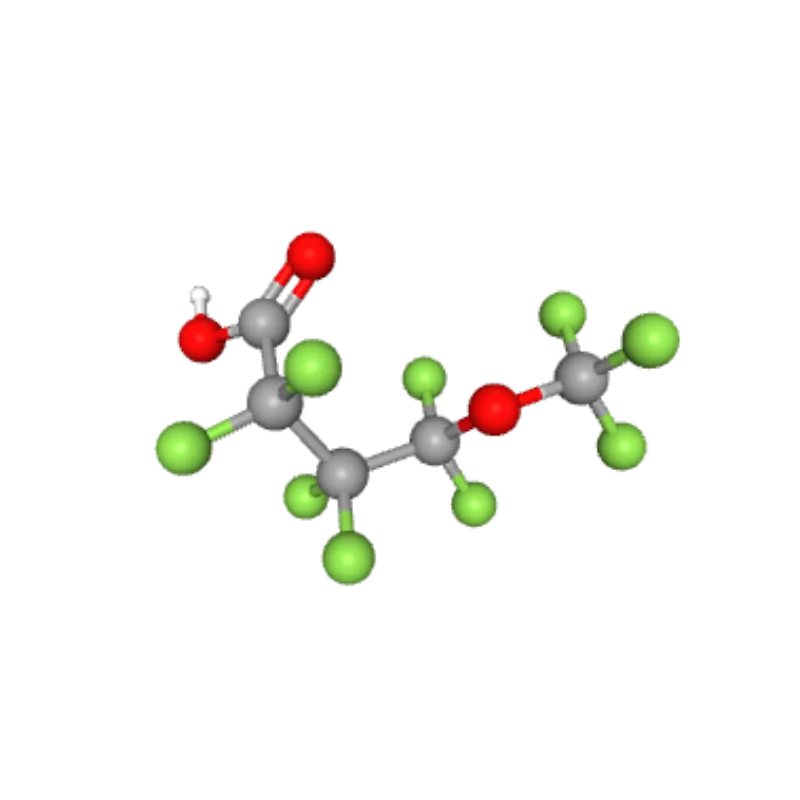
2,2,3,3,4,4-hexafluoro-4-(trifluoromethoxy)butanoic acid
Short-chain perfluoroether carboxylic acid (C3 acid + OCF3 ether, MW 280). Toxicology dataset is thin; risk class-extrapolated from PFAS. Detected at 9 utilities serving 130K people in MN, NY, and IA — among lowest UCMR 5 occurrence.
Primary concern: Class-extrapolated PFAS effects (limited individual toxicology)
Affected organ systems
Health effects
Exposure routes
Vulnerable populations
Overview
Perfluoro-4-methoxybutanoic acid (PFMBA, also abbreviated PFMOBA in some literature) is a short-chain perfluoroether carboxylic acid built from a 3-carbon perfluorinated acid backbone with a terminal trifluoromethoxy (-OCF3) ether group (C5HF9O3, MW 280). It is the structural near-twin of UCMR 5 sibling PFMPA — both compounds share the same 3-carbon perfluorocarboxylate body and differ only in the position of the ether oxygen — and is the smallest perfluoroether carboxylic acid in the UCMR 5 program. PFMBA is much smaller than the better-studied PFE-CAs in this catalog (HFPO-DA/GenX at MW 330, ADONA at MW 378, NFDHA at MW 296), and the published toxicology dataset is correspondingly thin. UCMR 5 places PFMBA among the lowest-occurrence analytes in the entire program: it has been detected at only 9 U.S. public water systems serving roughly 130,000 people across three states (Minnesota, New York, Iowa), with the highest reported average level — 0.950 ppt at Camanche, IA and Bells Pond Mobile Park, NY — sitting well below the UCMR 5 Minimum Reporting Level of 3 ppt (0.003 µg/L), so most detections are J-flagged estimated values below the formal quantitation limit.
Pollution sources
Sources
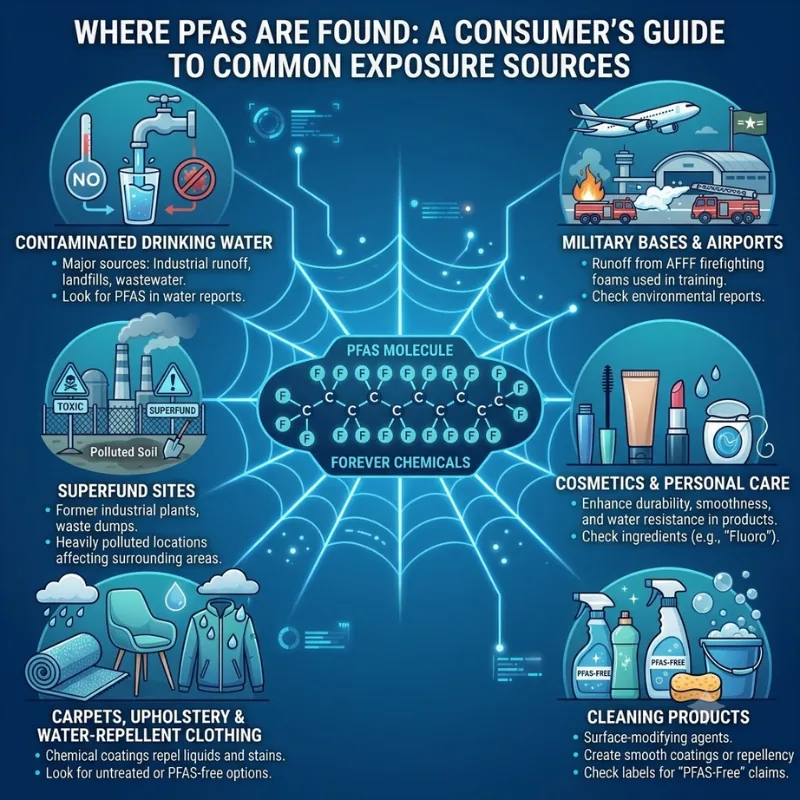
Documented sources of PFMBA in U.S. drinking water are limited because the occurrence dataset is so small, but four identifiable geographic patterns appear in the 9 detecting utilities. (1) 3M Cottage Grove influence area in Minnesota: the Oakdale, MN system (0.111 ppt, 4 of 19 tests) sits directly within the documented 3M Cottage Grove groundwater plume, and the Hastings, MN systems (Eagle's Watch Development at 0.240 ppt and city Hastings at 0.007 ppt) are downstream Mississippi River basin systems on the same regional aquifer. (2) Mississippi River Quad Cities corridor in Iowa: Camanche Water Supply (0.950 ppt, 3 of 14 tests) and Iowa-American Water Co. Clinton District (0.750 ppt, 2 of 8 tests) draw from Mississippi River source water near a documented historical industrial discharge corridor — this is a new geographic signature not seen in the prior 20 PFAS in this catalog. (3) Long Island, NY: Hicksville Water District (0.045 ppt over 126 tests, serving 48,000 people) sits within the documented Nassau County groundwater PFAS plume that also drives PFOA, PFOS, and PFHxS signal in the area. (4) Hudson Valley Columbia County, NY: Bells Pond Mobile Park North, Taconic Mobile Home Park, and Taconic Shores form the same small-utility cluster that drives the entire UCMR 5 PFEESA dataset, reinforcing the hypothesis of a shared regional source-water signature in that geography.
Health risks
There is no PFMBA-specific Reference Dose, Health Reference Level, or carcinogen classification from EPA, IARC, or NTP. PFMBA is not included in the 2024 NPDWR Hazard Index mixture (which covers PFHxS, PFNA, HFPO-DA, and PFBS) and has no individual federal MCL. Risk assessment is therefore class-extrapolated from the better-studied perfluoroether carboxylic acids (HFPO-DA / GenX, ADONA) and broader PFAS: the carbon-fluorine and ether-oxygen backbone is environmentally and biologically persistent, and the structural similarity to HFPO-DA implies likely hepatotoxic and immunotoxic potential at sufficient exposures. Pharmacokinetic data in humans is essentially absent — no defensible serum half-life has been published — but for a 3-carbon-acid PFE-CA, rapid excretion (days-to-weeks half-life) is the expected pattern by analogy with other short-chain perfluoroethers. EPA included PFMBA in UCMR 5 precisely to build the occurrence dataset that future toxicology work will need.
Effective treatments
Does not remove
NSF certifications
Water treatment
PFMBA is removed by the same processes that handle other short-chain perfluoroether acids: granular activated carbon (GAC), anion exchange resin, and high-pressure membranes (reverse osmosis, nanofiltration). The short perfluorinated chain and small molecular weight (MW 280) mean GAC adsorption is weaker than for long-chain PFAS like PFOA or PFOS — utilities sizing GAC for PFMBA should expect earlier breakthrough and shorter media life relative to legacy PFAS, mirroring the operational pattern observed with HFPO-DA, NFDHA, and PFMPA. Conventional treatment processes — coagulation, sand filtration, disinfection, UV, and ozonation — do not remove PFMBA. Boiling concentrates rather than removes it. NSF/ANSI 53 and NSF P473 certify point-of-use filters for general PFAS reduction; NSF/ANSI 58 covers RO systems. Because PFMBA is detected at only 9 small-to-medium utilities at very low ppt concentrations and is not in the federal NPDWR Hazard Index, dedicated treatment for PFMBA is not a practical compliance target — utilities meeting the NPDWR Hazard Index and individual long-chain PFAS MCLs with GAC, AIX, or RO will incidentally control PFMBA at the same time.
Gallery
Related contaminants
Chemistry + classification data sourced from public databases (PubChem, EPA CompTox, IARC monographs); 3D molecular models from 3d.nih.gov where available.