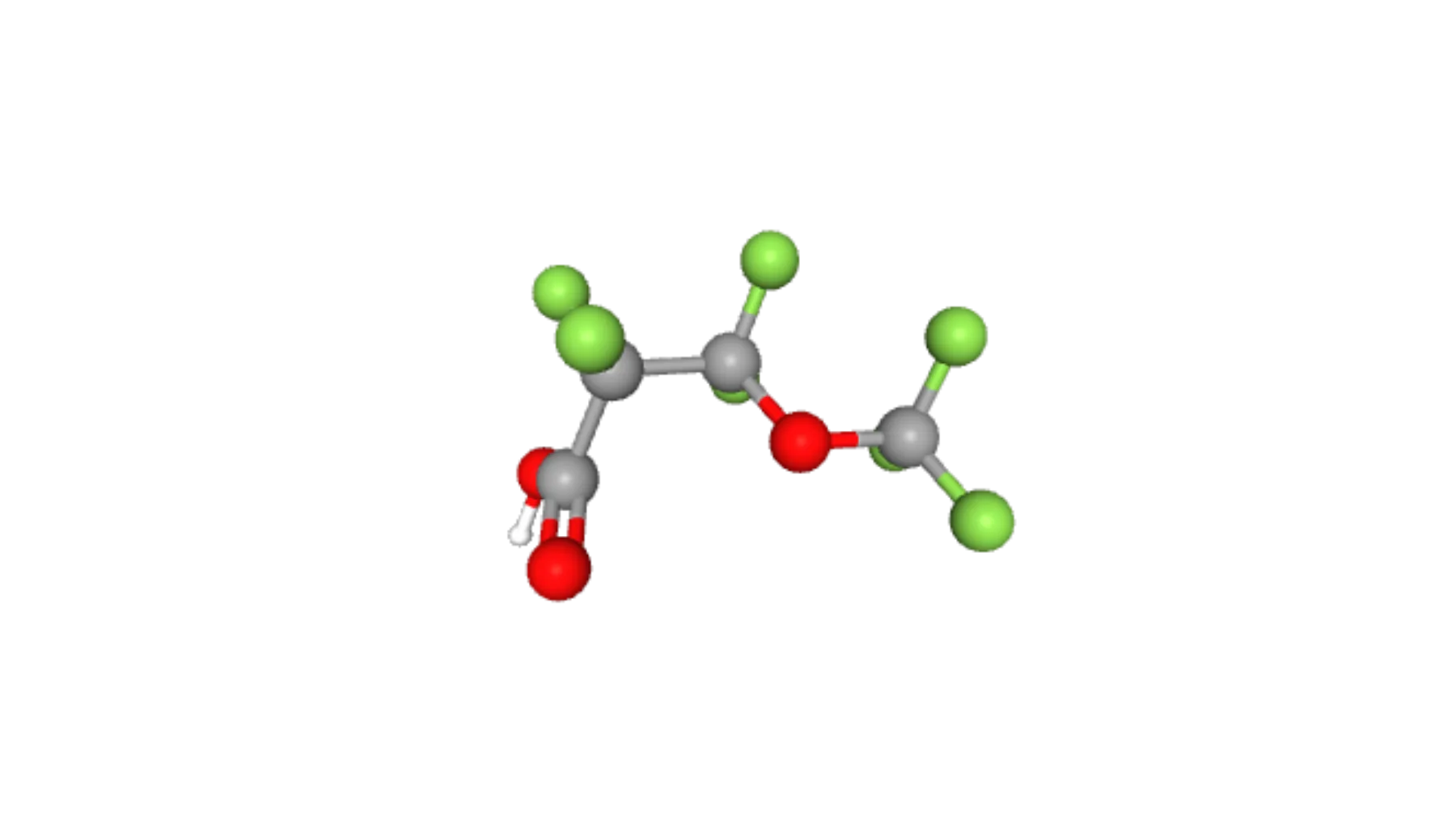
PFMPA
Propanoic acid, 2,2,3,3-tetrafluoro-3-(trifluorome...
2,2,3,3-tetrafluoro-3-(trifluoromethoxy)propanoic acid
Short-chain perfluoroether carboxylic acid (C2 acid + OCF3 ether, MW 230) — one -CF2- shorter than PFMBA. No EPA RfD; risk class-extrapolated from PFAS. Detected at 27 utilities serving 337K people; strong 3M Cottage Grove plume signature.
Primary concern: Class-extrapolated PFAS effects (limited individual toxicology)
Affected organ systems
Health effects
Exposure routes
Vulnerable populations
Overview
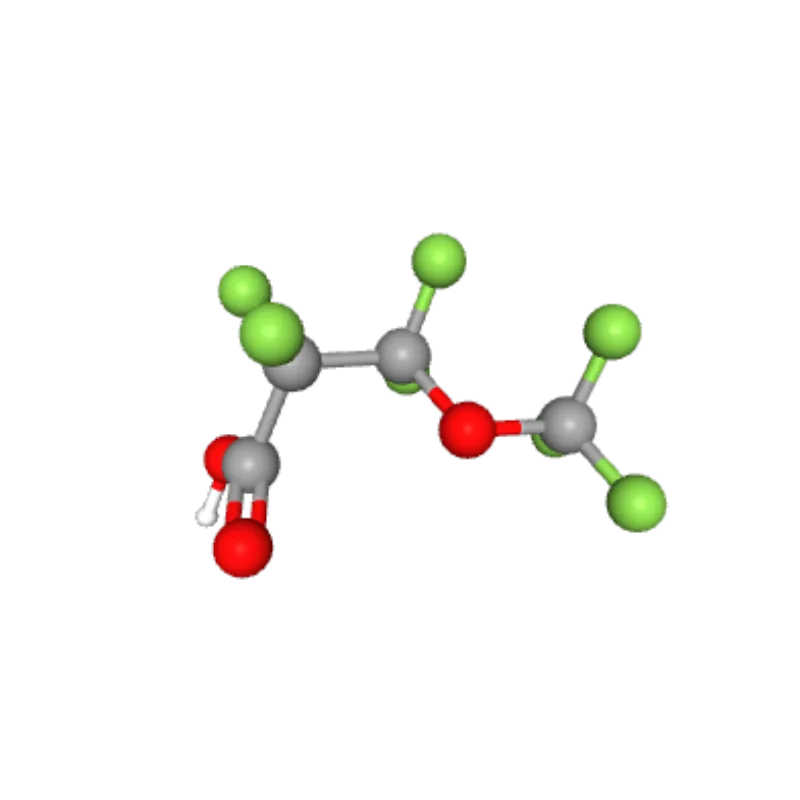
Perfluoro-3-methoxypropanoic acid (PFMPA, also abbreviated PFMOPrA) is a short-chain perfluoroether carboxylic acid built from a 2-carbon perfluorinated acid backbone with a terminal trifluoromethoxy (-OCF3) ether group (C4HF7O3, MW 230). It is one -CF2- unit shorter than its UCMR 5 sibling PFMBA and is the smallest perfluoroether carboxylic acid in the UCMR 5 analyte set. PFMPA has been detected at 27 U.S. public water systems serving roughly 337,000 people across five states (Minnesota, Iowa, Utah, New York, Texas), with the highest reported average level of 2.98 ppt at Cottage Grove, MN (25 of 31 tests positive). The UCMR 5 Minimum Reporting Level for PFMPA is 4 ppt (0.004 µg/L), so most detections are J-flagged estimated values below the formal quantitation limit.
Pollution sources
Sources
PFMPA detection is dominated by a single regional signature: the 3M Cottage Grove fluorochemical plume in the Twin Cities, MN metropolitan area. Cottage Grove itself measures the highest national average (2.98 ppt), and the surrounding plume-impacted communities account for the bulk of detections — Woodbury (0.755 ppt over 87 tests, 82,643 served), Hastings (0.876 ppt over 67 tests), Oakdale (0.893 ppt over 19 tests), Newport, Stillwater, Oak Park Heights, Apple Valley, South Saint Paul, and Cimarron Park in Lake Elmo. A secondary Mississippi River corridor pattern appears in Iowa: Iowa-American Water Co. Clinton District (2.44 ppt), Camanche Water Supply (2.09 ppt), and Muscatine Power & Water (0.077 ppt over 30 tests, 23,797 served). The Hudson Valley NY mobile-park cluster (Bells Pond, Taconic, Jennie Clarkson Home in Dobbs Ferry) and a single Utah detection (Twin Creeks Special Service District, Payson) round out the dataset. PFMPA is most often discussed in the literature as a fluorochemical processing intermediate and degradation product of larger perfluoroether precursors rather than as a high-volume commercial product in its own right.
Health risks
There is no PFMPA-specific Reference Dose, Health Reference Level, or carcinogen classification from EPA, IARC, or NTP, and PFMPA is not included in the 2024 NPDWR Hazard Index mixture or covered by an individual federal MCL. Risk assessment is therefore class-extrapolated from the better-studied perfluoroether carboxylic acids (HFPO-DA, ADONA) and broader PFAS: the carbon-fluorine and ether-oxygen backbone is environmentally and biologically persistent, and the structural family is consistently associated with hepatic, immune, and endocrine effects. Pharmacokinetic data in humans is absent — no defensible serum half-life has been published — but for a 2-carbon-acid PFE-CA, rapid excretion (days-to-weeks half-life) is the expected pattern by analogy with other short-chain perfluoroethers. EPA included PFMPA in UCMR 5 to build the occurrence dataset that future toxicology work will need.
Effective treatments
Does not remove
NSF certifications
Water treatment
PFMPA is removed by anion exchange resin and high-pressure membranes (reverse osmosis, nanofiltration) more effectively than by granular activated carbon — the very short perfluorinated chain and small molecular weight (MW 230) drive early GAC breakthrough, mirroring the operational pattern observed with HFPO-DA, NFDHA, and PFMBA. Conventional treatment processes — coagulation, sand filtration, disinfection, UV, and ozonation — do not remove PFMPA. Boiling concentrates rather than removes it. NSF/ANSI 53 and NSF P473 certify point-of-use filters for general PFAS reduction; NSF/ANSI 58 covers RO systems. Because PFMPA is not in the federal NPDWR Hazard Index and is detected at relatively small concentrations at a limited utility footprint, dedicated PFMPA treatment is not a practical compliance target — utilities meeting NPDWR Hazard Index and individual long-chain PFAS MCLs with AIX or RO will incidentally control PFMPA at the same time.
Gallery
Related contaminants
Chemistry + classification data sourced from public databases (PubChem, EPA CompTox, IARC monographs); 3D molecular models from 3d.nih.gov where available.