
Is the Water You're Drinking Slowly Making You Sterile?
In today's world, where we are constantly bombarded with information about health and wellness, it's easy to overlook the impact of something as simple as the water we drink. Yet the quality of that water can have a significant effect on our overall health — including our reproductive health. In this article, we explore the connection between water quality and fertility, and look at some of the contaminants that may quietly undermine it.
What are endocrine-disrupting chemicals (EDCs)?
One group of contaminants is of particular concern: endocrine-disrupting chemicals (EDCs). These chemicals interfere with the body's hormone system, which can lead to a variety of health problems, including fertility issues. Some of the most common EDCs include pesticides, plasticizers, and pharmaceuticals — many of which can find their way into a water supply.
Common EDCs found in water
EDCs are not a single substance but a broad family of chemicals that share one trait: they meddle with hormone signaling. Here are some of the most common culprits.
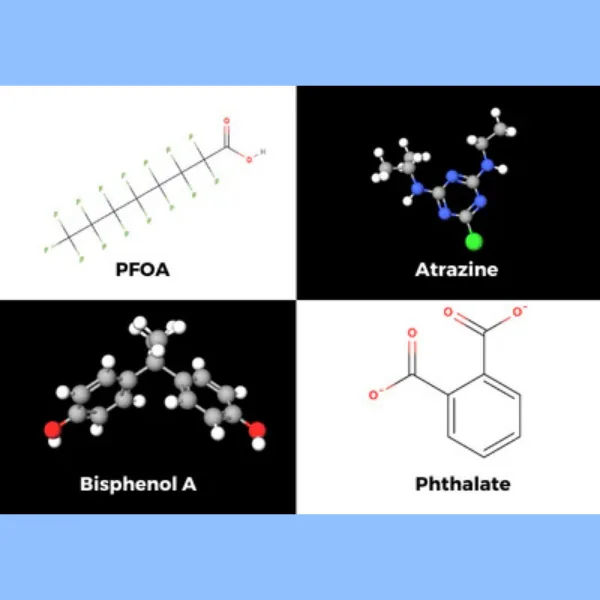
- Pesticides like DDT, atrazine, chlorpyrifos, and glyphosate can infiltrate water and food supplies. These chemicals can mimic or block hormone receptors, leading to abnormal hormonal signaling and disrupting the endocrine system's delicate balance.
- Plasticizers such as bisphenol A (BPA) and phthalates (like DEHP and DBP), found in many plastics, can leach into food and water. They can bind to hormone receptors, interfering with natural hormone signaling and potentially affecting reproductive development and function.
- Heavy metals, including lead, mercury, and arsenic, can contaminate water sources and interfere with hormone production and function, leading to a range of endocrine-related health problems.
- Industrial chemicals like polychlorinated biphenyls (PCBs), dioxins, and perfluorinated compounds (PFCs) can persist in the environment, accumulate in the body, and disrupt hormone signaling — potentially affecting the reproductive, immune, and nervous systems.
- Flame retardants, such as polybrominated diphenyl ethers (PBDEs), can accumulate in dust and the environment and interfere with thyroid hormone production, potentially impacting metabolism and development.
- Personal care products containing parabens and triclosan can introduce EDCs into the body through skin absorption and water runoff, disrupting hormone signaling and potentially affecting reproductive health.
- Pharmaceutical residues (PPCPs) are one of the most overlooked sources. Trace amounts of medications — synthetic estrogens from birth-control pills, hormone-replacement therapies, antidepressants, and antibiotics — pass through the human body, enter the sewage stream, and survive conventional wastewater treatment, which was never designed to remove them. They re-enter the rivers and reservoirs that feed municipal supplies. The concern is potency: hormonally active compounds like synthetic estrogen (EE2) can disrupt endocrine signaling at concentrations as low as nanograms per liter. The well-documented feminization of fish populations downstream of treatment-plant outfalls is a stark real-world illustration of how little it takes.
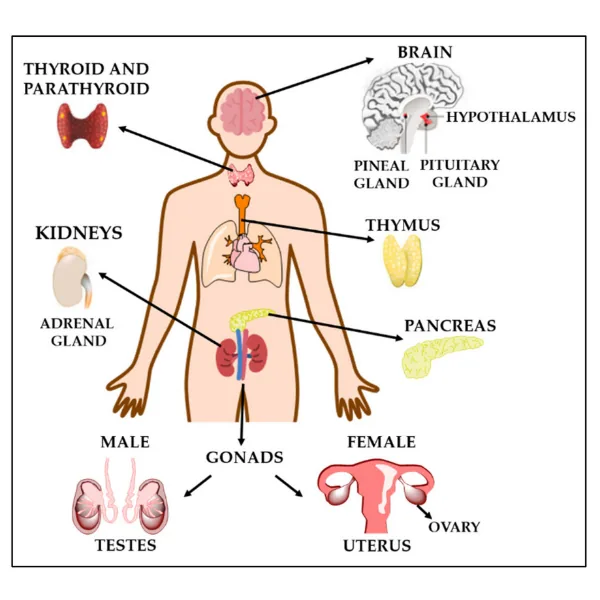
Which body systems do EDCs affect?
EDCs in the water supply can affect a wide range of organs and systems throughout the body. The specific effects — and the severity of the impact — vary depending on the type of EDC, the level of exposure, and individual factors like age and genetics.
Reproductive system
In women, EDCs are associated with a range of reproductive health risks, including irregular menstrual cycles, early puberty, and an increased risk of endometriosis. These disruptions can also make it more difficult to conceive — underscoring the importance of clean water for female reproductive health and overall well-being.
In men, exposure to EDCs can directly impact fertility, potentially leading to decreased sperm count, reduced sperm quality, and even testicular abnormalities. This can significantly increase the risk of infertility, making it a critical concern for anyone planning a family.
Endocrine system
- Thyroid — a crucial regulator of metabolism, the thyroid is particularly vulnerable to EDCs, which can disrupt thyroid hormone production. This can lead to weight changes, fatigue, and mood disturbances.
- Adrenal glands — responsible for managing stress, the adrenal glands can be affected by EDCs that interfere with the production of stress hormones, disrupting the body's natural stress response.
- Pituitary gland — the master regulator of hormone production. Disruptions here can have far-reaching effects, impacting everything from growth and development to reproductive function.
Nervous system
Children are especially vulnerable to the neurodevelopmental effects of EDCs, with potential consequences like reduced IQ, learning disabilities, and behavioral problems. Emerging research also suggests that long-term exposure may increase the risk of neurodegenerative diseases later in life — a reminder to minimize exposure across a lifetime, not just during pregnancy.
Immune, metabolic, and cardiovascular systems
- Immune system — EDCs can weaken the immune response, making the body more susceptible to infections.
- Metabolic system — exposure has been linked to an increased risk of obesity and type 2 diabetes.
- Cardiovascular system — some studies suggest an increased risk of heart disease.
Liver and kidneys
The liver and kidneys — the body's detoxification powerhouses — can be strained by the constant effort to process EDCs. Reducing EDC exposure through cleaner water helps support these vital organs.
Reducing your exposure through better water
You can't control every source of EDCs — but drinking water is one of the most controllable, and it's a source you contact every single day. The reassuring part is that the same multi-stage filtration used to remove contaminants like PFAS and chlorine byproducts is also well-suited to the EDC families described above. The key insight is that no single filter catches everything: different EDCs are removed by different stages, which is exactly why a layered system works.
How each stage targets a different class of EDC
- Carbon stages capture the organic EDCs. Activated carbon works by adsorption — organic molecules adhere to its enormous internal surface area. This is precisely the mechanism that pulls out the carbon-based EDCs: BPA, phthalates (DEHP, DBP), pesticides like atrazine and glyphosate, PCBs, flame retardants, and pharmaceutical residues. For this large share of EDCs, a quality carbon block does the heavy lifting.
- The RO membrane captures the dissolved and ionic contaminants. A reverse osmosis membrane rejects contaminants by molecular size and electrical charge, with pores on the order of 0.0001 microns. That makes it the stage responsible for the contaminants carbon struggles with: heavy metals (lead, mercury, arsenic), PFAS "forever chemicals," nitrates, and other dissolved salts.
Because EDCs span both groups — oily organics and charged dissolved ions — a multi-stage system that pairs carbon with an RO membrane delivers the broadest protection. Either stage on its own leaves a gap: a carbon-only filter lets dissolved metals slip through, while a bare membrane is less efficient at trapping some of the smallest organic molecules. Used together, the two stages cover the full spectrum of EDCs we've walked through in this article.
Maintenance is what keeps it working
Filtration only protects you while the media is fresh. A carbon filter that has reached its adsorption capacity stops removing organics — and can even begin shedding what it previously captured back into your water — while a fouled or aging RO membrane gradually loses its rejection efficiency. Consistent maintenance and timely filter replacements are what keep a system performing as designed, year after year.
By taking control of your water quality this way, you eliminate one significant, daily source of EDC exposure — a meaningful, proactive step toward protecting your hormonal health, your fertility, and that of future generations.