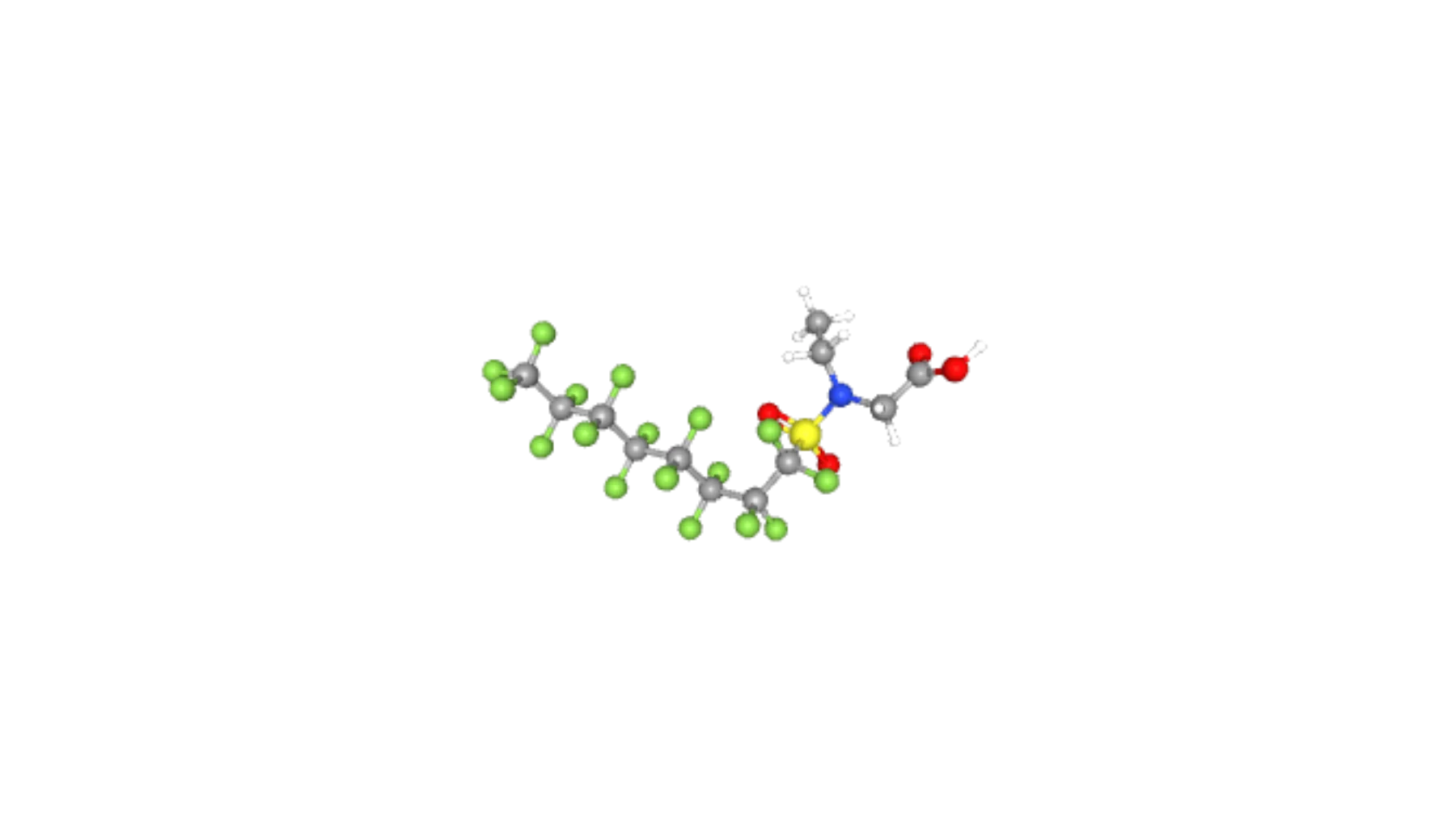
NEtFOSAA
N-ethyl perfluorooctane sulfonamido acetic acid
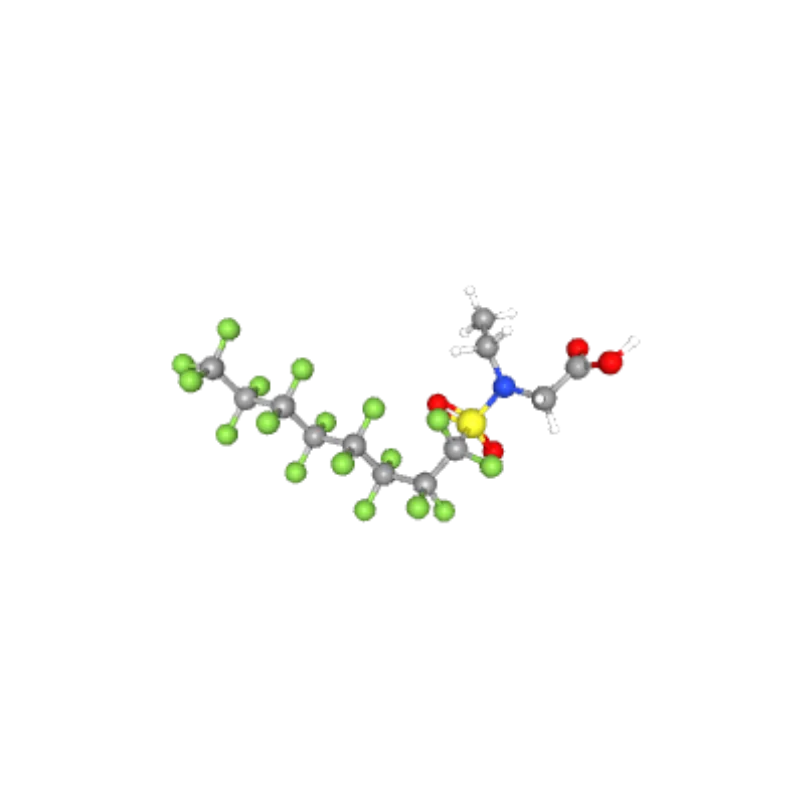
2-[ethyl(1,1,2,2,3,3,4,4,5,5,6,6,7,7,8,8,8-heptadecafluorooctylsulfonyl)amino]acetic acid
A perfluoroalkylsulfonamidoacetic acid and breakdown product of EtFOSE/EtFOSA precursors used in 3M Scotchgard-era fluorochemical products through 2002. Highly persistent; detected at low ppt levels in U.S. drinking water under UCMR 5.
Primary concern: Immune and liver toxicity
Affected organ systems
Health effects
Exposure routes
Vulnerable populations
Overview
N-ethyl perfluorooctane sulfonamidoacetic acid (NEtFOSAA) is a perfluoroalkylsulfonamidoacetic acid — a structural cousin to PFOS, with the perfluorooctyl sulfonate group joined through a nitrogen-ethyl bridge to a glycine moiety. It was never a primary commercial product itself but was a major impurity and environmental breakdown intermediate of the N-ethyl perfluorooctane sulfonamide (EtFOSA) and ethanol (EtFOSE) chemistries that 3M used for decades in Scotchgard and related stain-, grease-, and water-repellent coatings on paper, textiles, food packaging, and carpet. 3M voluntarily phased out the EtFOSE/EtFOSA chemistry by 2002, but legacy contamination is widespread: NEtFOSAA has been detected in 205 U.S. public water systems serving roughly 2.6 million people under EPA's UCMR 5 monitoring program.
Pollution sources
Sources
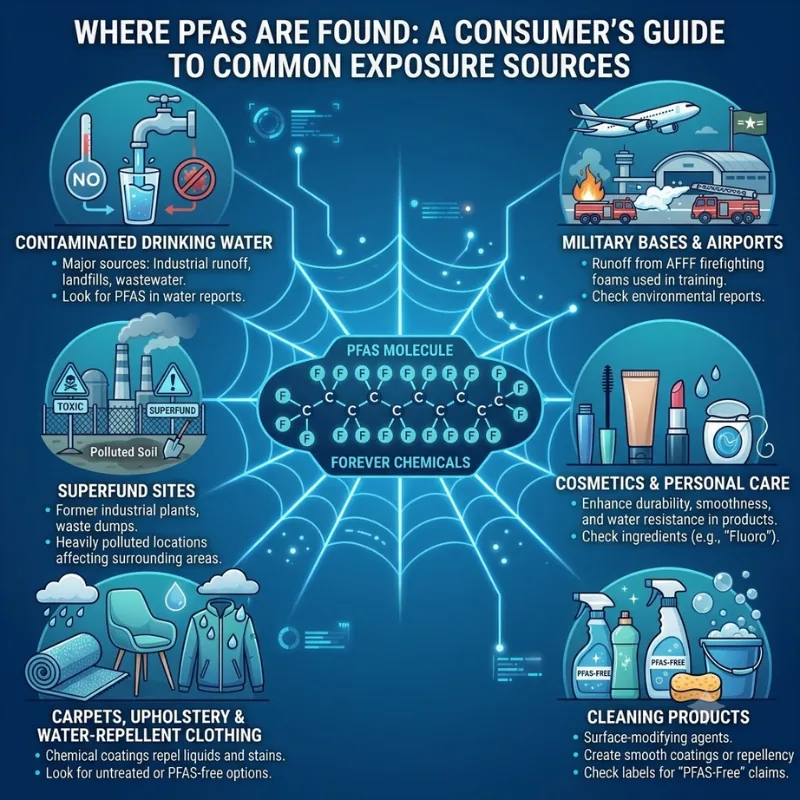
NEtFOSAA enters drinking water primarily through three pathways: (1) direct industrial discharges from former 3M and licensee manufacturing facilities, (2) leachate from landfills that received 3M-coated consumer products before the 2002 phaseout, and (3) atmospheric deposition and groundwater migration from aqueous film-forming foam (AFFF) release sites where the parent EtFOSE and EtFOSA chemistries were used. Because NEtFOSAA biotransforms over months-to-years into PFOS, sites with elevated NEtFOSAA today typically also show elevated PFOS in groundwater and serum. UCMR 5 results cluster in Massachusetts, Michigan, New York, and the upper Midwest — notably the Wausau, WI Waterworks recorded 4.31 ppt across 7 of 7 tests, a pattern consistent with a single concentrated source upgradient.
Health risks
NEtFOSAA has not been formally classified as a carcinogen by IARC or NTP, and its standalone toxicological dataset is smaller than that of its terminal degradation product PFOS. The principal health concern is that NEtFOSAA serves as a body-burden source of PFOS: once ingested it undergoes slow oxidative biotransformation in the liver to perfluorooctanesulfonate, contributing to lifetime PFOS exposure and the well-documented PFOS endpoints — immune suppression, hepatotoxicity, thyroid disruption, developmental effects, and elevated cholesterol. Direct in-vitro and animal studies of NEtFOSAA itself have also reported hepatic, endocrine, and developmental effects at moderate doses. NEtFOSAA is monitored under UCMR 5 but is not currently subject to a federal MCL.
Effective treatments
Does not remove
NSF certifications
Water treatment
NEtFOSAA is removed effectively by granular activated carbon (GAC), anion exchange resin, and high-pressure membranes including reverse osmosis and nanofiltration. Its long perfluorinated chain and ionizable carboxylate group give it strong adsorption affinity on GAC media — comparable to or slightly greater than PFOS itself. Conventional treatment processes — coagulation, sand filtration, disinfection, UV, and ozonation — do not remove it. Boiling concentrates rather than removes it. NSF/ANSI 53 and NSF P473 certify point-of-use filters for PFAS reduction; NSF/ANSI 58 covers RO systems. Treatment plants targeting NEtFOSAA should also expect simultaneous removal of the parent compounds EtFOSA, EtFOSE, and the PFOS daughter product.
Gallery
Related contaminants
Chemistry + classification data sourced from public databases (PubChem, EPA CompTox, IARC monographs); 3D molecular models from 3d.nih.gov where available.