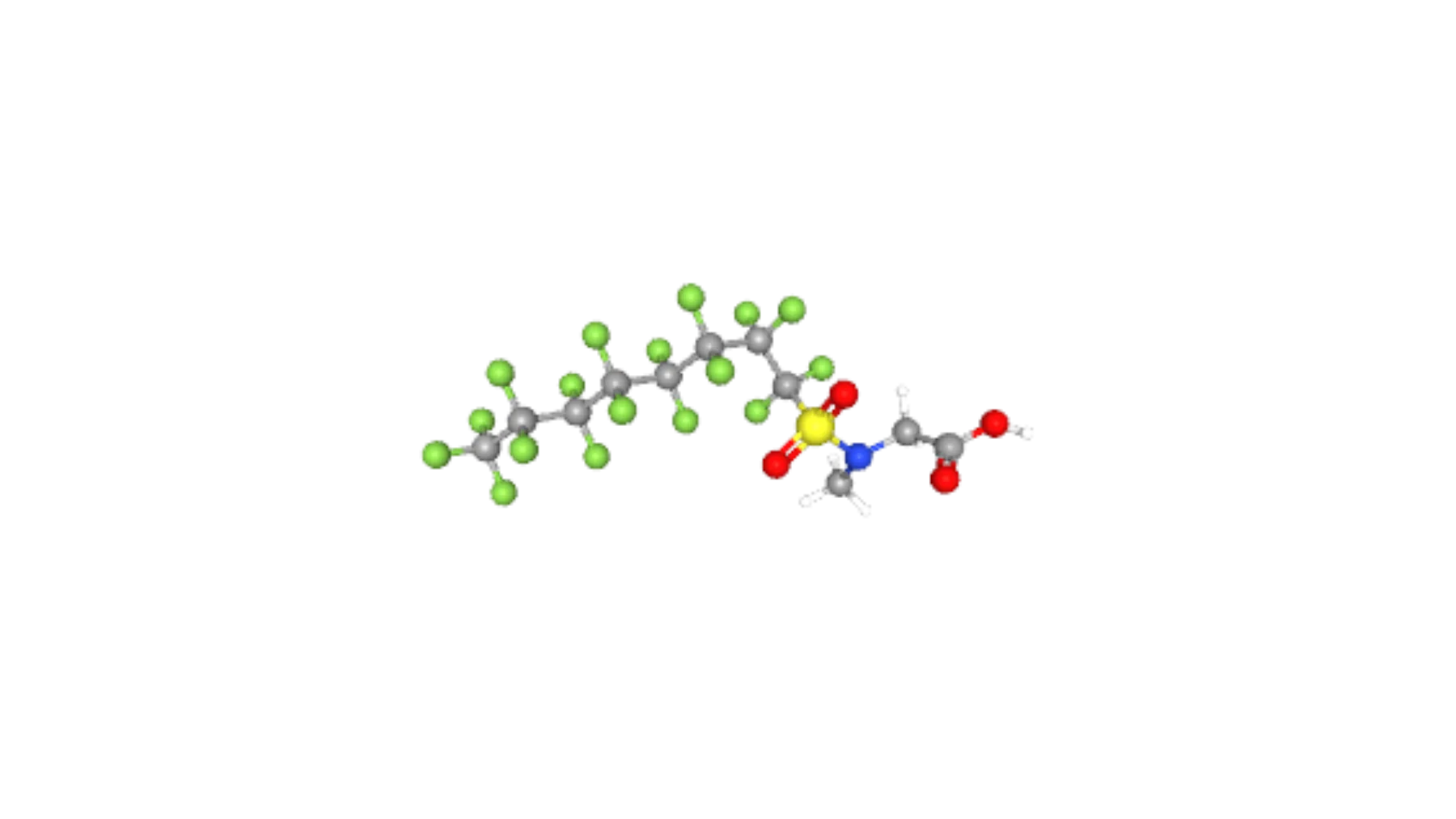
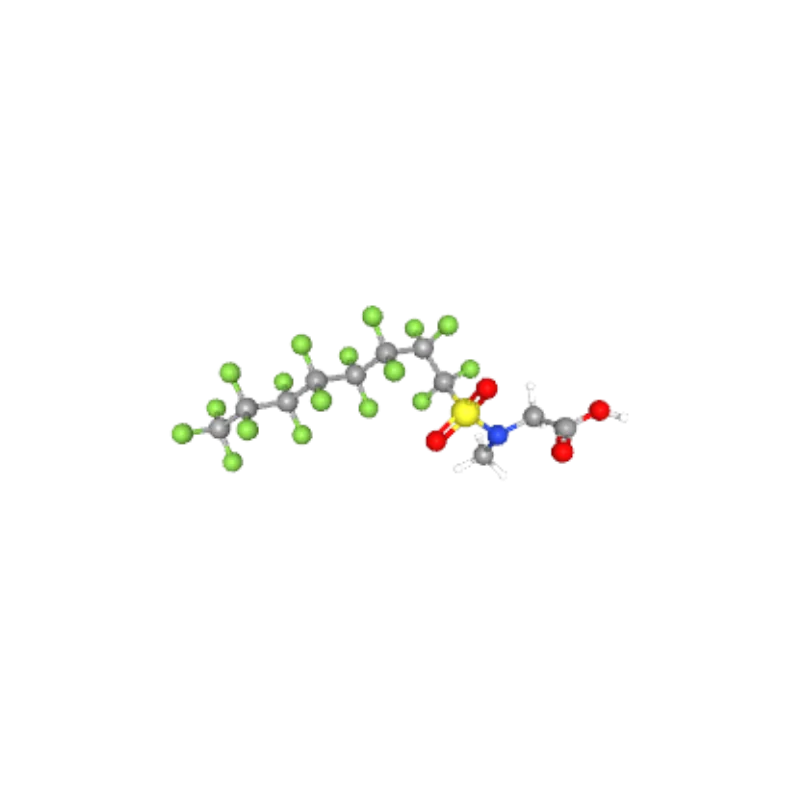
NMeFOSAA
N-methyl perfluorooctanesulfonamidoacetic acid
2-[1,1,2,2,3,3,4,4,5,5,6,6,7,7,8,8,8-heptadecafluorooctylsulfonyl(methyl)amino]acetic acid
An N-methyl perfluoroalkylsulfonamidoacetic acid; breakdown product of MeFOSE/MeFOSA precursors used in 3M Scotchgard-era products through 2002. Highly persistent; detected at low ppt levels in U.S. drinking water under UCMR 5.
Primary concern: Immune and liver toxicity
Affected organ systems
Health effects
Exposure routes
Vulnerable populations
Overview
N-methyl perfluorooctane sulfonamidoacetic acid (NMeFOSAA) is the N-methyl sibling of NEtFOSAA — a perfluoroalkylsulfonamidoacetic acid with the perfluorooctyl sulfonate group joined through a nitrogen-methyl bridge to a glycine moiety. Like its ethyl analogue, it was never sold as a primary product but was a major impurity and environmental breakdown intermediate of the N-methyl perfluorooctane sulfonamide (MeFOSA) and ethanol (MeFOSE) chemistries that 3M used for decades in Scotchgard and related stain-, grease-, and water-repellent coatings on paper, textiles, food packaging, and carpet. 3M voluntarily phased out the MeFOSE/MeFOSA chemistry by 2002, but legacy contamination is widespread: NMeFOSAA has been detected in 144 U.S. public water systems serving roughly 1.8 million people under EPA's UCMR 5 monitoring program, with Massachusetts accounting for 87 of the 144 affected utilities.
Pollution sources
Sources
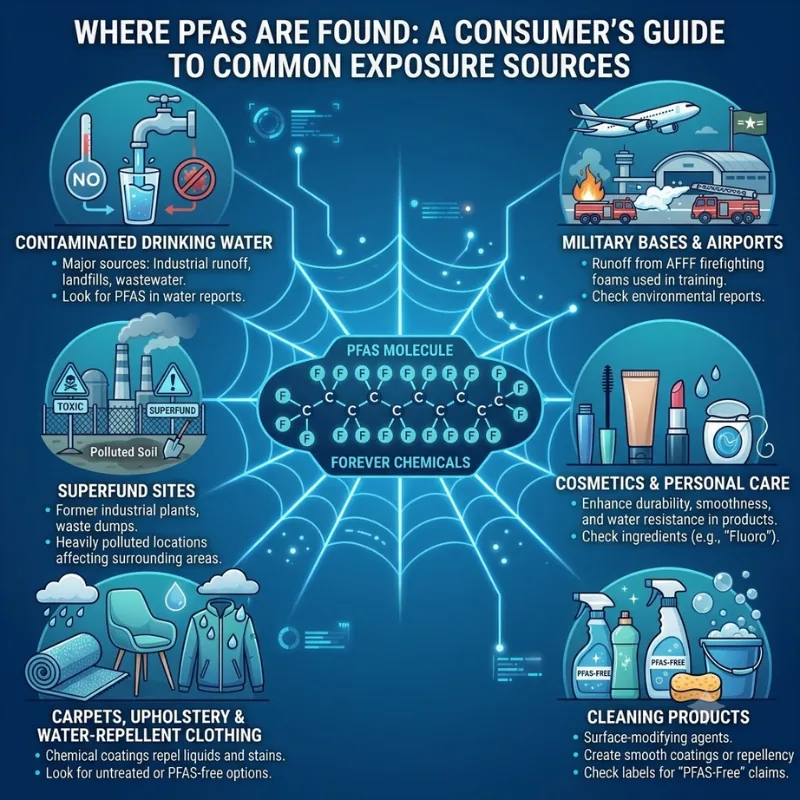
NMeFOSAA enters drinking water through the same three pathways as NEtFOSAA: (1) direct industrial discharges from former 3M and licensee manufacturing facilities, (2) leachate from landfills that received 3M-coated consumer products before the 2002 phaseout, and (3) atmospheric deposition and groundwater migration from aqueous film-forming foam (AFFF) release sites where the parent MeFOSE and MeFOSA chemistries were used. Because NMeFOSAA biotransforms over months-to-years into PFOS, sites with elevated NMeFOSAA today typically also show elevated PFOS in groundwater and serum. The Massachusetts cluster — 87 of 144 utilities — reflects both the state's dense industrial history and its proactive PFAS testing program; outside MA, the highest U.S. level (9.55 ppt at Montevallo, AL) and the chronic-source pattern at Seekonk, MA (16 of 21 tests positive at 1.51 ppt) both point to identifiable upgradient industrial or AFFF source areas.
Health risks
NMeFOSAA has not been formally classified as a carcinogen by IARC or NTP, and its standalone toxicological dataset is smaller than that of its terminal degradation product PFOS. The principal health concern is that NMeFOSAA serves as a body-burden source of PFOS: once ingested it undergoes slow oxidative biotransformation in the liver to perfluorooctanesulfonate, contributing to lifetime PFOS exposure and the well-documented PFOS endpoints — immune suppression, hepatotoxicity, thyroid disruption, developmental effects, and elevated cholesterol. Direct in-vitro and animal studies of NMeFOSAA itself have also reported hepatic, endocrine, and developmental effects at moderate doses. NMeFOSAA is monitored under UCMR 5 but is not currently subject to a federal MCL.
Effective treatments
Does not remove
NSF certifications
Water treatment
NMeFOSAA is removed effectively by granular activated carbon (GAC), anion exchange resin, and high-pressure membranes including reverse osmosis and nanofiltration. Its long perfluorinated chain and ionizable carboxylate group give it strong adsorption affinity on GAC media — comparable to its ethyl sibling NEtFOSAA and to PFOS itself. Conventional treatment processes — coagulation, sand filtration, disinfection, UV, and ozonation — do not remove it. Boiling concentrates rather than removes it. NSF/ANSI 53 and NSF P473 certify point-of-use filters for PFAS reduction; NSF/ANSI 58 covers RO systems. Treatment plants targeting NMeFOSAA should also expect simultaneous removal of the parent compounds MeFOSA, MeFOSE, and the PFOS daughter product.
Gallery
Related contaminants
Chemistry + classification data sourced from public databases (PubChem, EPA CompTox, IARC monographs); 3D molecular models from 3d.nih.gov where available.