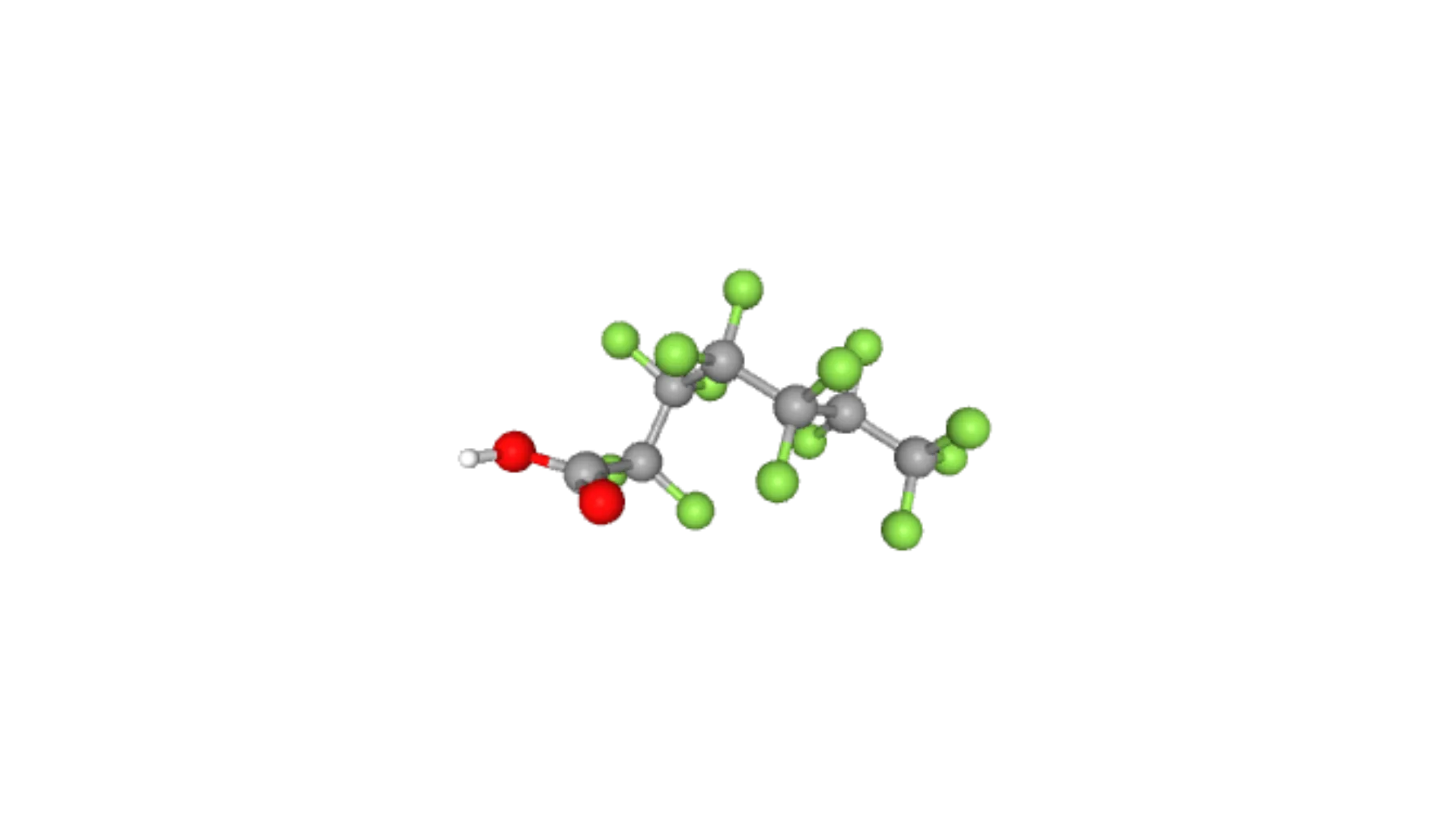
PFHpA
Perfluoroheptanoic acid
2,2,3,3,4,4,5,5,6,6,7,7,7-tridecafluoroheptanoic acid
A 7-carbon short-chain perfluorocarboxylic acid, one shorter than PFOA. Risk-assessed by surrogate to EPA's 2023 PFHxA IRIS toxicity value; detected in 2,568 U.S. public water systems serving 63M people.
Primary concern: Developmental and immune effects (PFHxA-surrogate)
Affected organ systems
Health effects
Exposure routes
Vulnerable populations
Overview
Perfluoroheptanoic acid (PFHpA) is a 7-carbon perfluoroalkyl carboxylic acid (C7HF13O2, MW 364) — one perfluorinated -CF2- unit shorter than PFOA, and at the long end of what OECD classifies as short-chain PFCAs (≤7 carbons). Its shorter perfluorinated chain relative to PFOA gives PFHpA higher water solubility and shorter human serum half-life: published estimates from Worley 2017 (Decatur, AL cohort) put the median PFHpA half-life at roughly 70 days, more than twenty-fold shorter than PFOA's ~3-year half-life. PFHpA is one of the most widely detected PFAS in UCMR 5 and pre-UCMR 5 occurrence data: 2,568 U.S. public water systems serving roughly 63 million people across 41 states have measured PFHpA. Risk is class-extrapolated from EPA's PFHxA IRIS toxicity value as a short-chain surrogate, on the basis that PFHpA and PFHxA share elimination behavior closer to short-chain than to the long-chain (PFOA / PFOS / PFDA) family. Reported detections sit far below the long-chain PFAS health benchmarks; the highest measured average in the UCMR 5 dataset is 58.4 ppt (Pittsboro, NC and Chapel Ridge S/d, NC).
Pollution sources
Sources
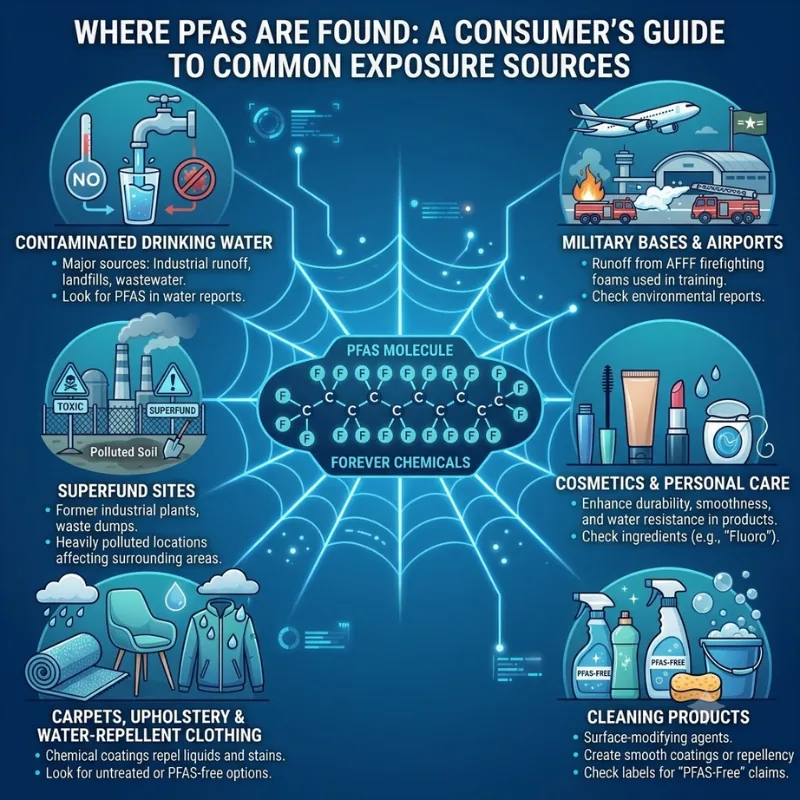
PFHpA reaches drinking water through three main routes: (1) industrial discharges from fluoropolymer manufacturing and metal-plating mist suppressants — the densest PFHpA detection cluster in the country is in central North Carolina (Pittsboro, Harnett County, Holly Springs, Coats, Lillington and Fuquay-Varina all measuring 29.6-58.4 ppt), all downstream of the Chemours Fayetteville Works plume in the Cape Fear River basin that also drives the regional PFOA, PFDA and HFPO-DA signal; (2) AFFF firefighting-foam release sites at military installations and civilian airports — Carle Place, NY (28.1 ppt over 164 tests) sits within the documented Nassau County Long Island groundwater PFAS plume that traces to Navy and Air National Guard AFFF use; and (3) environmental biotransformation of 6:2 fluorotelomer and longer fluorotelomer precursors used in stain-, grease-, and water-resistant coatings on textiles, paper and food packaging — PFHpA is a common terminal degradation product of these telomer chemistries and accounts for much of the diffuse, non-cluster background detection seen in Florida, Massachusetts and New Jersey.
Health risks
EPA has not finalized a PFHpA-specific IRIS toxicological review or Reference Dose; risk assessment uses the agency's 2023 PFHxA IRIS toxicity value as a short-chain surrogate, on the basis that the two compounds share short-chain elimination behavior and likely similar dose-response shapes for developmental and hepatic endpoints. Class-extrapolated endpoints commonly listed for PFHpA are cancer, immune system damage, hormone disruption, harm to fetal growth and child development, and harm to the liver — these come from broader PFAS-class evidence rather than a PFHpA-specific cancer or non-cancer endpoint, and PFHpA has not been formally classified as a carcinogen by IARC or NTP. Human pharmacokinetic data for PFHpA is better than for most short-chain PFAS: serum half-life is much shorter than long-chain PFCAs (~70 days vs ~3 years for PFOA), which is part of the rationale for short-chain rather than long-chain risk framing. PFHpA is not included in the 2024 NPDWR Hazard Index mixture and has no individual federal MCL.
Effective treatments
Does not remove
NSF certifications
Water treatment
PFHpA is one of the harder UCMR 5 PFCAs to remove cost-effectively with granular activated carbon: short-chain PFCAs adsorb weakly onto GAC media and break through earlier than long-chain PFOA or PFDA of comparable concentration, mirroring the operational pattern observed for PFBA and PFHxA. Anion exchange resins and high-pressure membranes (reverse osmosis, nanofiltration) are more effective than GAC for short-chain PFCAs and should be the lead technology if PFHpA reduction is the primary design target. Conventional treatment processes — coagulation, sand filtration, disinfection, UV, and ozonation — do not remove PFHpA. Boiling concentrates rather than removes it. NSF/ANSI 53 and NSF P473 certify point-of-use filters for general PFAS reduction; NSF/ANSI 58 covers RO systems. Because PFHpA is not in the federal NPDWR Hazard Index and reported concentrations sit well below short-chain PFAS health benchmarks, dedicated PFHpA treatment is rarely the design driver — utilities sizing GAC, anion exchange, or RO for PFOA / PFOS / PFHxS / HFPO-DA / PFNA NPDWR compliance will incidentally control PFHpA at the same time.
Gallery
Related contaminants
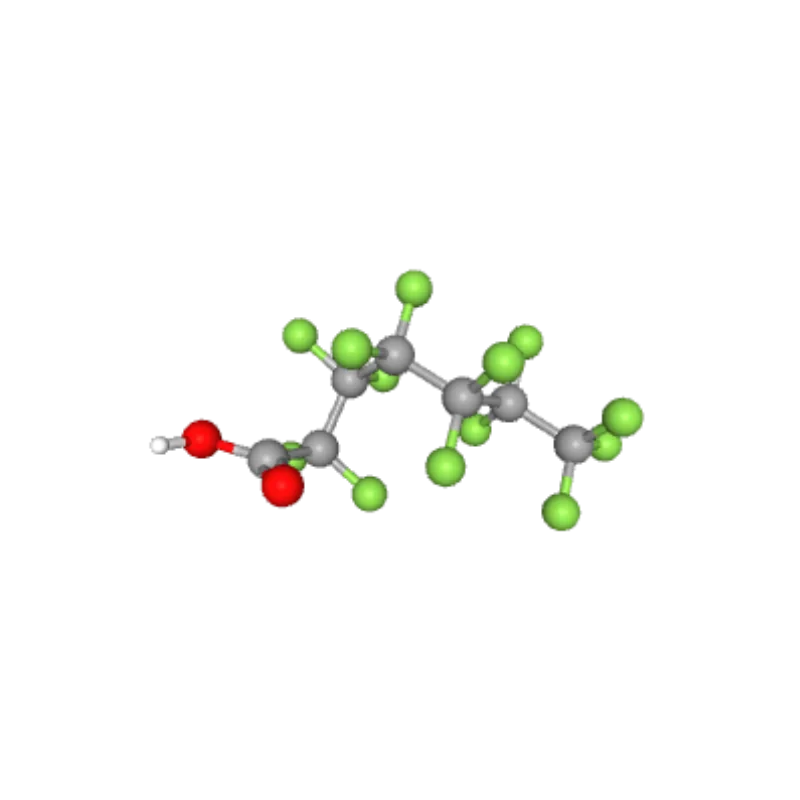
Chemistry + classification data sourced from public databases (PubChem, EPA CompTox, IARC monographs); 3D molecular models from 3d.nih.gov where available.