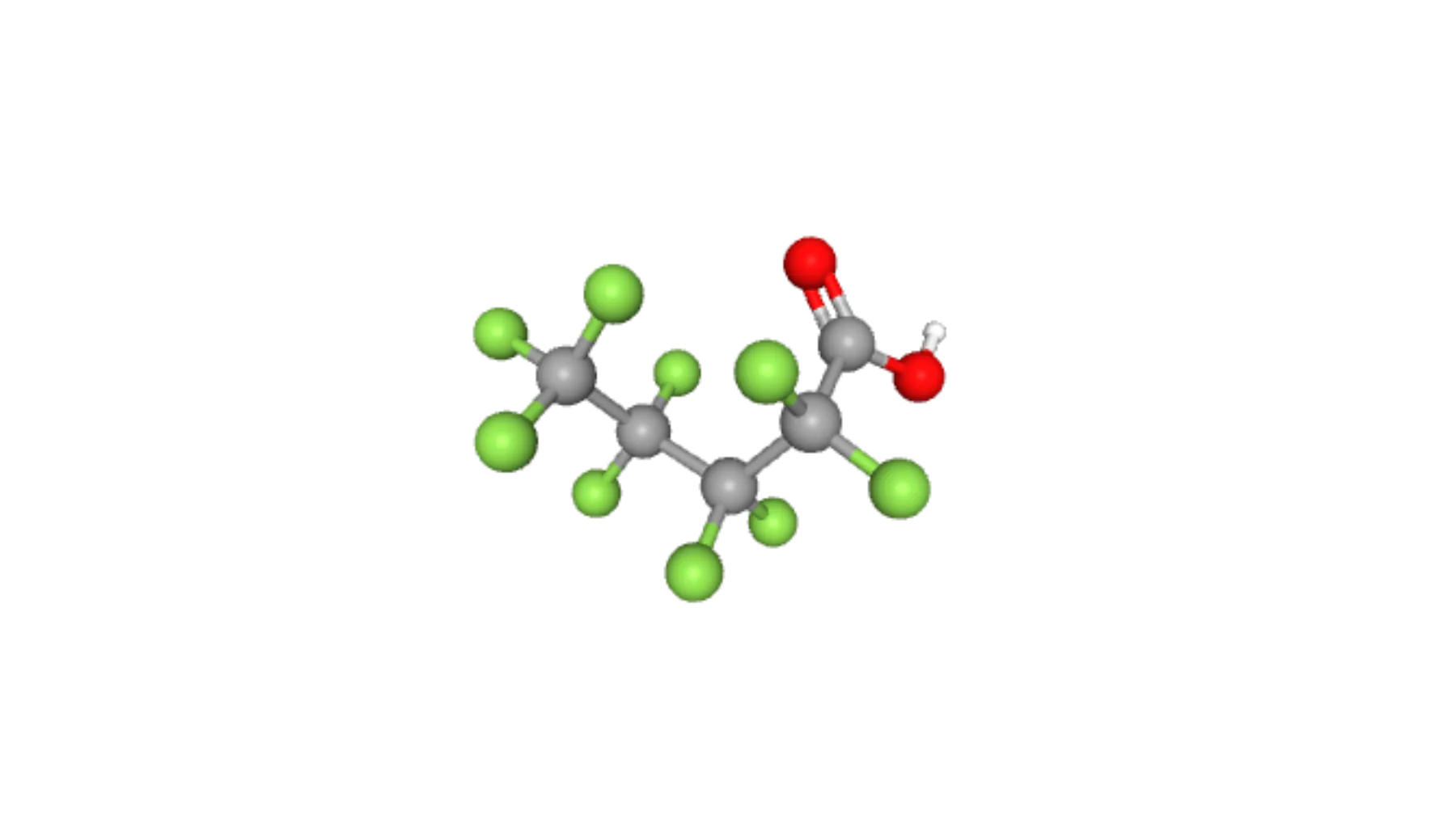
PFPeA
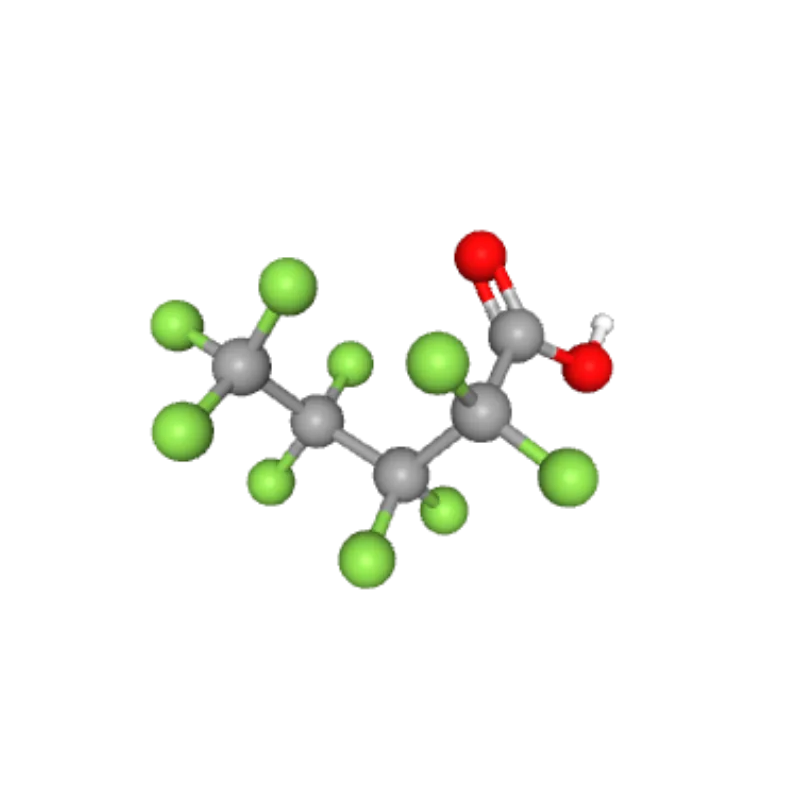
Perfluoropentanoic Acid
2,2,3,3,4,4,5,5,5-nonafluoropentanoic acid
A 5-carbon short-chain PFCA between PFBA and PFHxA. No PFPeA-specific EPA RfD; class-extrapolated from PFHxA IRIS. Detected at 3,076 utilities serving 101M people across 46 states; TX Gulf Coast and MI signatures dominant.
Primary concern: Developmental effects (class-extrapolated, PFHxA-surrogate)
Affected organ systems
Health effects
Exposure routes
Vulnerable populations
Overview
Perfluoropentanoic acid (PFPeA) is a 5-carbon perfluoroalkyl carboxylic acid (C5HF9O2, MW 264) — one perfluorinated -CF2- unit longer than PFBA, one shorter than PFHxA, and one of the top-three most widely detected PFAS in U.S. drinking water under UCMR 5. PFPeA is highly water-soluble and fast-eliminating in humans: published estimates put the median serum half-life at roughly 14 days (Worley 2017 Decatur AL cohort), placing PFPeA between PFBA (~3 days) and PFHxA (~30 days) on the short-chain elimination spectrum. There is no PFPeA-specific EPA IRIS Reference Dose; drinking-water health benchmarks are class-extrapolated from EPA's 2023 IRIS RfD for PFHxA (5×10⁻⁴ mg/kg/day). PFPeA has been detected at 3,076 U.S. public water systems serving roughly 101 million people across 46 states.
Pollution sources
Sources
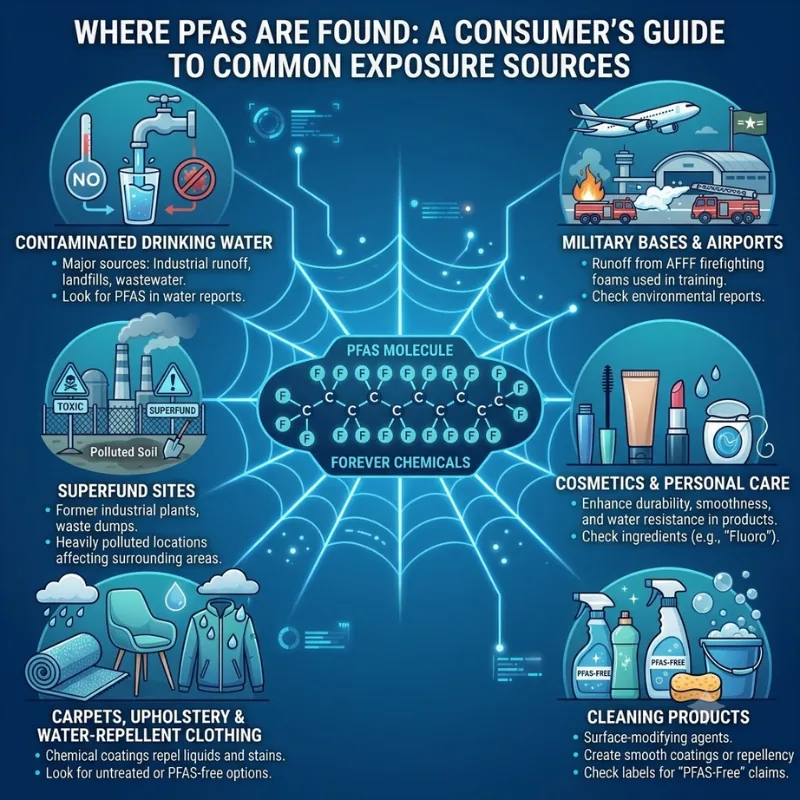
PFPeA reaches drinking water through three principal pathways: (1) industrial discharges and atmospheric deposition from fluoropolymer and fluorochemical manufacturing — the Texas Gulf Coast cluster (Sugar Land at 71.9 ppt serving 90,909 people, Freeport at 99.2 ppt, Clute at 70.2 ppt, Angleton at 64.8 ppt, Galveston County WCID systems at 58-86 ppt, and Cameron at 252.0 ppt — the highest measured U.S. average) reflects regional petrochemical and specialty-chemical impacts, and a broad Michigan cluster spanning Lake Huron / Lake Michigan shoreline systems (Wyandotte at 41.0 ppt, Detroit, Saginaw, Sanilac Township, Lexington, Worth Township, Charlevoix, Traverse City, Grand Haven, Muskegon, Norton Shores) reflects the state's historical fluorochemical and metal-plating corridor; (2) AFFF firefighting-foam release at military installations and civilian airports — Widefield WSD in Colorado Springs (33.5 ppt) sits within the Peterson Space Force Base AFFF impact area, and Fort Drum, NY (18.1 ppt over 44 tests) is a direct on-base detection; (3) environmental biotransformation of 5:1 and 6:2 fluorotelomer precursors used in stain-, grease-, and water-resistant coatings on textiles, paper, and food packaging. Additional cluster signatures include the NC Cape Fear basin Chemours fingerprint (Harnett County, Lillington, Coats, Linden, Fuquay-Varina, Pittsboro and Chapel Ridge S/d all at 37.2-44.0 ppt), the Gadsden, AL Etowah County metals-finishing district (43.4 ppt across multiple co-located systems), and the 3M Cottage Grove, MN plume (Oakdale at 20.3 ppt, Cottage Grove at 18.8 ppt, Hastings at 13.3 ppt).
Health risks
There is no PFPeA-specific Reference Dose, Health Reference Level, or carcinogen classification from EPA, IARC, or NTP. PFPeA is not included in the 2024 NPDWR Hazard Index mixture (which covers PFHxS, PFNA, HFPO-DA, and PFBS) and has no individual federal MCL. Risk assessment is class-extrapolated from EPA's 2023 IRIS toxicological review of PFHxA — the structurally adjacent 6-carbon short-chain PFCA — which identifies developmental effects (reduced fetal growth and offspring body weight) as the dose-defining endpoint and yields a chronic Reference Dose of 5×10⁻⁴ mg/kg/day. Health-concern endpoints reported across the short-chain PFCA family include developmental effects, hepatotoxicity, immune effects, and endocrine/thyroid disruption. PFPeA has the second-shortest characterized human serum half-life of any UCMR 5 PFAS (~14 days, behind only PFBA at ~3 days), which is part of the rationale for the comparatively permissive class-extrapolated guidelines applied to short-chain PFCAs versus the part-per-trillion single-digit benchmarks applied to long-chain PFCAs like PFOA, PFDA, and PFNA.
Effective treatments
Does not remove
NSF certifications
Water treatment
PFPeA is among the harder UCMR 5 PFAS to remove cost-effectively because of its very short perfluorinated chain. Granular activated carbon (GAC) adsorbs PFPeA only weakly — short-chain PFCAs break through GAC media earlier than long-chain PFOA, PFDA, or PFOS at comparable loading rates, mirroring the operational pattern observed with PFBA and PFHxA. Anion exchange resin and high-pressure membranes (reverse osmosis, nanofiltration) substantially outperform GAC for PFPeA and should be the lead technology when PFPeA reduction is a primary design target. Conventional treatment processes — coagulation, sand filtration, disinfection, UV, and ozonation — do not remove PFPeA. Boiling concentrates rather than removes it. NSF/ANSI 53 and NSF P473 certify point-of-use filters for general PFAS reduction; NSF/ANSI 58 covers RO systems. Because PFPeA is not in the federal NPDWR Hazard Index and is detected at relatively low ppt levels at most utilities, dedicated PFPeA treatment is rarely the design driver — utilities sizing GAC, anion exchange, or RO for the NPDWR-regulated long-chain PFAS will incidentally control PFPeA at the same time, though with shorter media life than the long-chain compounds drive on their own.
Gallery
Related contaminants
Chemistry + classification data sourced from public databases (PubChem, EPA CompTox, IARC monographs); 3D molecular models from 3d.nih.gov where available.