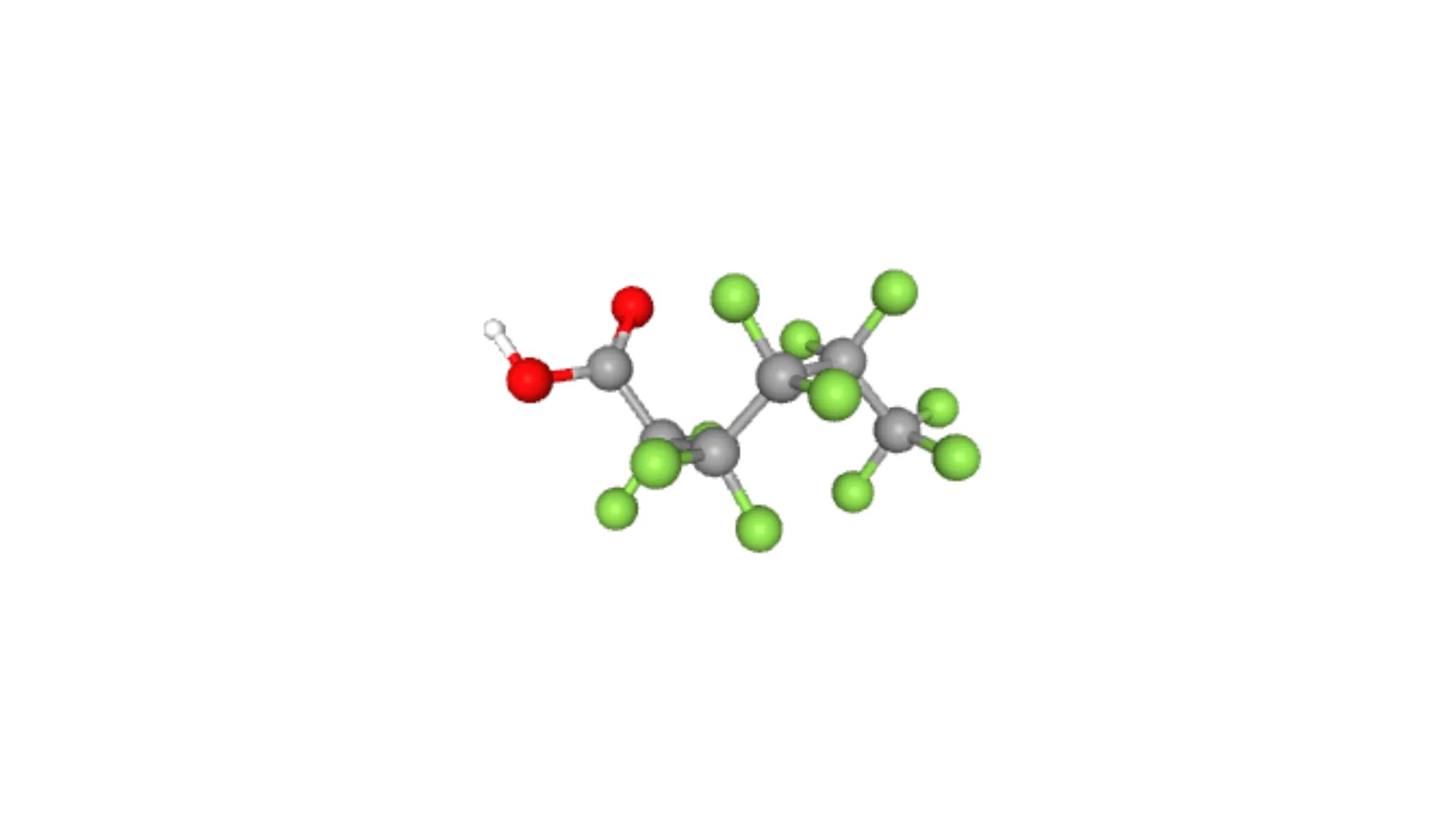
PFHxA
Perfluorohexanoic Acid
2,2,3,3,4,4,5,5,6,6,6-undecafluorohexanoic acid
A 6-carbon short-chain perfluorocarboxylic acid. EPA finalized the 2023 IRIS RfD (5×10⁻⁴ mg/kg/day) — PFHxA serves as the short-chain surrogate basis for PFHpA. 4,198 U.S. utilities serving 111M people detected.
Primary concern: Developmental effects (IRIS-derived)
Affected organ systems
Health effects
Exposure routes
Vulnerable populations
Overview
Perfluorohexanoic acid (PFHxA) is a 6-carbon perfluoroalkyl carboxylic acid (C6HF11O2, MW 314) — among the most widely detected PFAS in U.S. drinking water under UCMR 5, with 4,198 public water systems serving roughly 111 million people across 44 states reporting detections. Its high water solubility (~15,700 mg/L) and short human serum elimination half-life (around 30 days, based on Russell 2013 and Worley 2017 cohort estimates) place it firmly in the short-chain PFCA family — orders of magnitude faster-eliminating than long-chain PFOA (~3 years) or PFOS (~5 years). PFHxA matters disproportionately to the rest of the UCMR 5 PFAS set because it is one of only two analytes (alongside PFOA) with a final EPA IRIS toxicological review and Reference Dose: EPA finalized the IRIS RfD of 5×10⁻⁴ mg/kg/day in 2023, and the same value serves as the short-chain surrogate basis for several other PFAS in this catalog including PFHpA. The widespread presence of PFHxA reflects its post-2002 role as the replacement chemistry for legacy long-chain PFCAs — paradoxically, the same regulatory pressure that drove PFOA and PFOS out of consumer products drove PFHxA and its precursors in.
Pollution sources
Sources
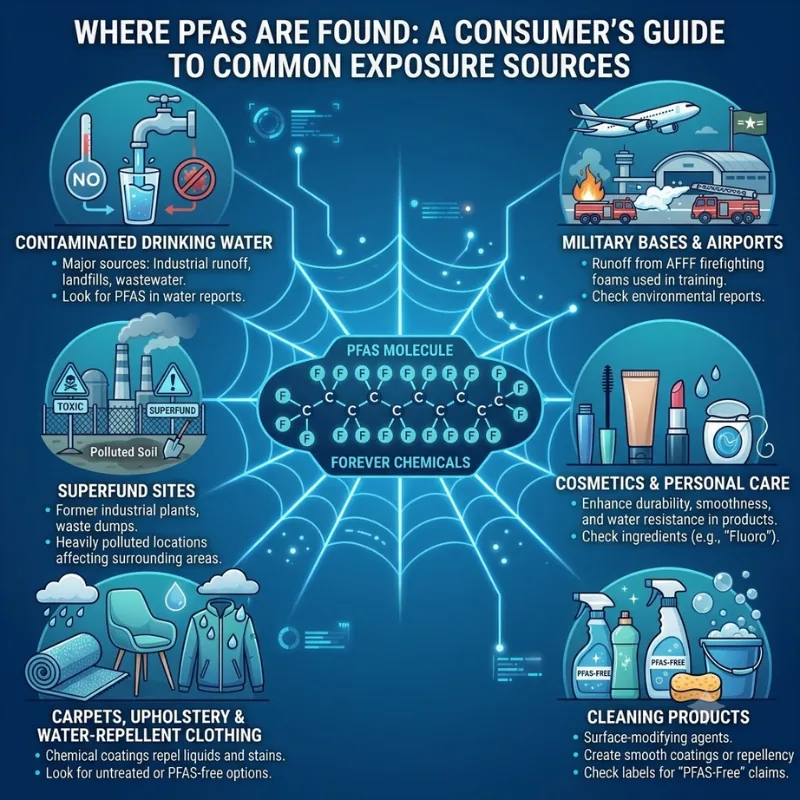
PFHxA enters U.S. drinking water through four overlapping pathways: (1) industrial discharge and atmospheric deposition from fluoropolymer and fluorochemical manufacturing — the North Carolina Cape Fear River cluster (Pittsboro, Harnett County, Holly Springs, Coats, Lillington, Linden and Fuquay-Varina, all measuring a uniform 60.4 ppt) is downstream of the Chemours Fayetteville Works plume, and the Oakdale, MN system (96 of 193 tests positive at 33.4 ppt) draws from the well-documented 3M Cottage Grove groundwater plume; (2) AFFF firefighting-foam release at military installations and civilian airports — small isolated systems with the highest measured PFHxA averages (Sunny Gables, ME at 143.7 ppt; Towns Mobile Home Park, WA at 132.0 ppt; Friendly Acres, CA at 97.4 ppt; Pine Terrace, WA at 85.6 ppt) almost always trace to local AFFF release patterns; (3) environmental biotransformation of 6:2 fluorotelomer precursors used in stain-, grease-, and water-resistant coatings on textiles, paper, and food packaging — 6:2 telomer-based replacement chemistries degrade preferentially to PFHxA, which explains the broad diffuse baseline detection across California, Texas, Florida, and the northeastern manufacturing corridor; and (4) regional industrial legacy at sites like Gadsden Water Works, AL (39 of 42 tests positive at 26.4 ppt over the Etowah County metals-finishing district).
Health risks
EPA's 2023 IRIS toxicological review identifies developmental effects — specifically reduced fetal growth and offspring body weight — as the dose-defining endpoint for PFHxA, yielding a chronic Reference Dose of 5×10⁻⁴ mg/kg/day. USGS uses that RfD to derive a Health-Based Screening Level of 3,000 ng/L (3 µg/L). Commonly listed PFHxA health concerns — cancer, immune system damage, hormone disruption, fetal/developmental harm, and liver damage — span both the IRIS-derived developmental endpoint of record and class-extrapolated concerns shared across the PFAS family. PFHxA has not been classified as a carcinogen by IARC or NTP. PFHxA is not in the 2024 NPDWR Hazard Index mixture (the Hazard Index covers PFHxS, PFNA, PFBS, and HFPO-DA) and has no individual federal MCL. The much shorter ~30-day human serum half-life relative to long-chain PFCAs is the principal reason PFHxA risk framing sits at the part-per-trillion thousand-level rather than the ppt single-digit level applied to PFOA, PFDA, or HFPO-DA.
Effective treatments
Does not remove
NSF certifications
Water treatment
PFHxA is one of the more difficult UCMR 5 PFAS to remove cost-effectively with granular activated carbon: short-chain PFCAs adsorb only weakly onto GAC media and break through far earlier than long-chain PFOA, PFDA, or PFOS at comparable loading rates. Anion exchange resin and high-pressure membranes (reverse osmosis, nanofiltration) substantially outperform GAC for PFHxA and should be the lead technology when PFHxA reduction is a primary design target — though for most U.S. utilities PFHxA is detected well below the IRIS-derived health benchmark and treatment economics rarely justify retrofitting for PFHxA alone. Conventional treatment processes — coagulation, sand filtration, disinfection, UV, and ozonation — do not remove PFHxA. Boiling concentrates rather than removes it. NSF/ANSI 53 and NSF P473 certify point-of-use filters for general PFAS reduction; NSF/ANSI 58 covers RO systems. Because PFHxA is not in the federal NPDWR Hazard Index and reported U.S. detections sit well below the IRIS-derived screening range, utilities sizing GAC, anion exchange, or RO for the NPDWR-regulated long-chain PFAS will incidentally control PFHxA at the same time (though with shorter media life than the long-chain compounds drive on their own).
Gallery
Related contaminants
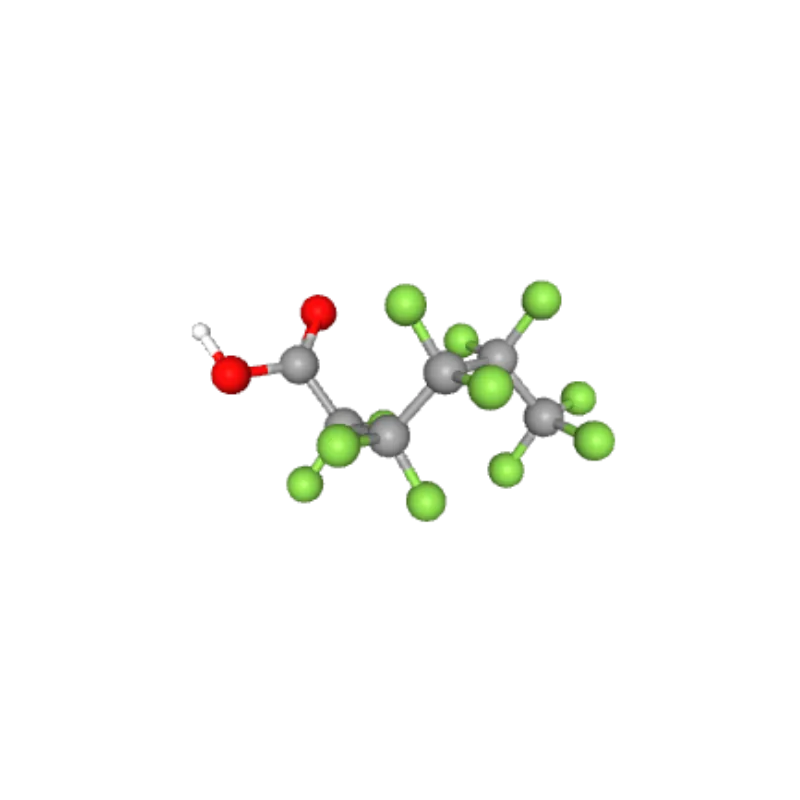
Chemistry + classification data sourced from public databases (PubChem, EPA CompTox, IARC monographs); 3D molecular models from 3d.nih.gov where available.