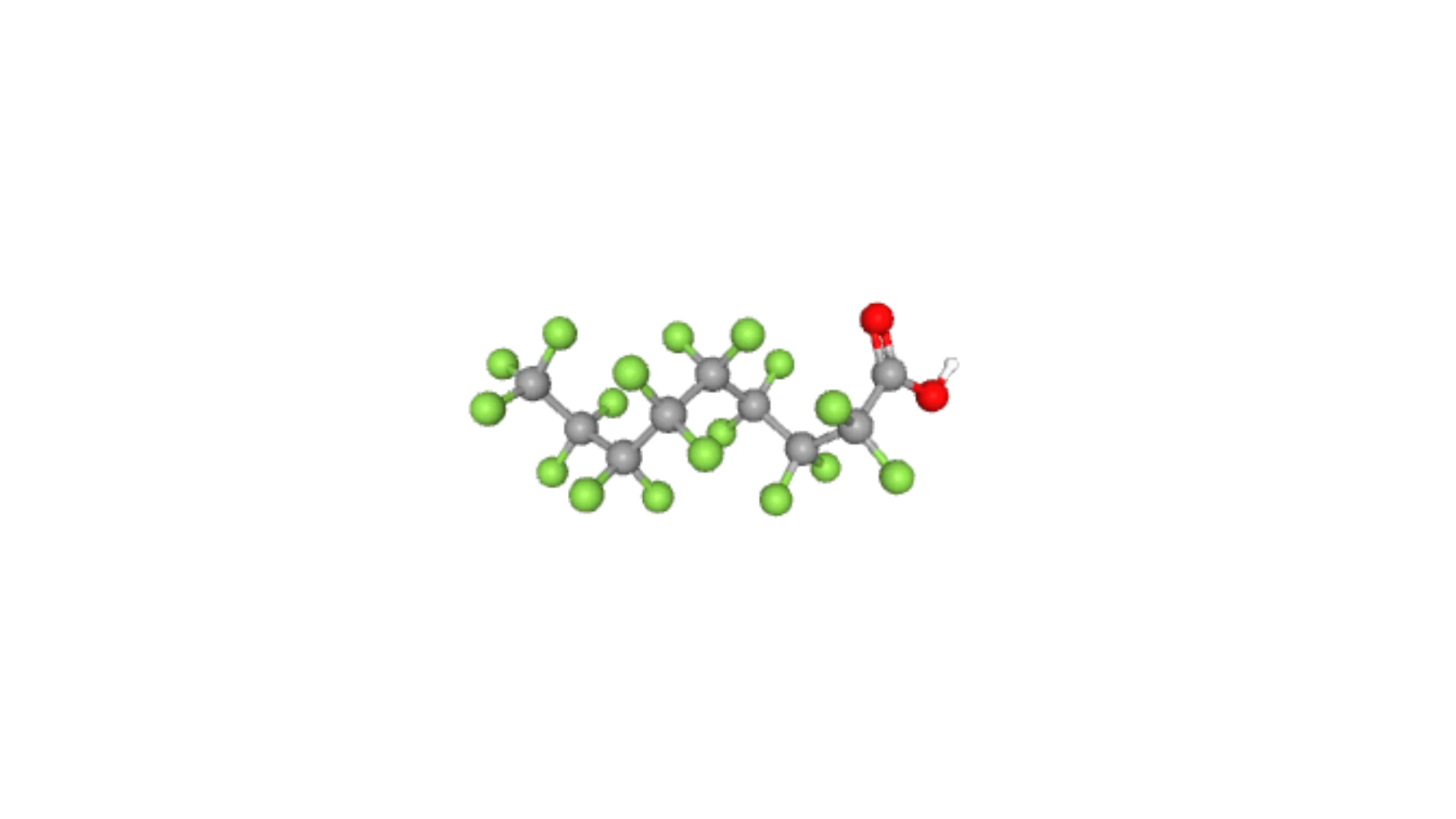
PFNA
Perfluorononanoic acid
2,2,3,3,4,4,5,5,6,6,7,7,8,8,9,9,9-heptadecafluorononanoic acid
A 9-carbon long-chain PFCA with 2024 NPDWR individual MCL of 10 ppt. Same regulatory class as PFOA; principal source is Solvay's South Jersey manufacturing plume. Detected at 894 U.S. utilities serving 26M people across 28 states.
Primary concern: Developmental and immune effects (NPDWR-regulated)
Affected organ systems
Health effects
Exposure routes
Vulnerable populations
Overview
Perfluorononanoic acid (PFNA, also abbreviated C9) is a 9-carbon perfluoroalkyl carboxylic acid (C9HF17O2, MW 464) — one perfluorinated -CF2- unit longer than PFOA, and the longest individually MCL-regulated PFCA in the 2024 NPDWR. EPA finalized the federal MCL at 10 parts per trillion with a matching MCLG of 10 ppt; the MCLG is not zero because IARC has not classified PFNA as a Group 1 carcinogen, unlike PFOA. PFNA is also a regulated component of the NPDWR Hazard Index mixture alongside PFHxS, HFPO-DA, and PFBS. Its long perfluorinated chain gives PFNA low water solubility, strong serum-protein binding, and a multi-year human elimination half-life — published central estimates cluster around 2.5 years (Worley 2017 Decatur AL cohort; Olsen 2009 3M production-worker cohort). PFNA has been detected at 894 U.S. public water systems serving roughly 26 million people across 28 states.
Pollution sources
Sources
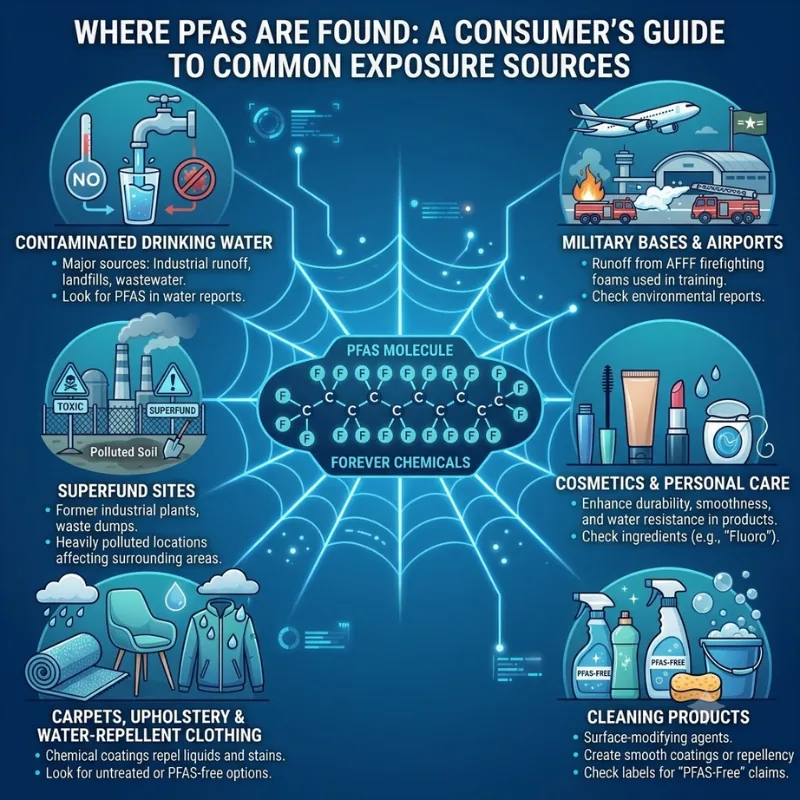
PFNA contamination of U.S. drinking water has a distinctive geographic fingerprint dominated by a single industrial source: Solvay Specialty Polymers' fluoropolymer manufacturing plant at West Deptford / Paulsboro, New Jersey (formerly operated by Arkema and Atofina). PFNA served as a polymerization aid at the plant from the mid-1980s onward, and direct discharge plus atmospheric deposition produced an extensive groundwater plume across Gloucester County and surrounding South Jersey communities — the UCMR 5 detection list reflects this directly, with the National Park Water Department (15.3 ppt), Brooklawn Water Department (12.5 ppt, 20 of 20 tests positive), Westville Water Department (12.1 ppt, 23 of 23 tests), Gloucester City Water Department (11.3 ppt), and East Greenwich Township (13.6 ppt) forming a tight cluster of utilities all exceeding the federal 10 ppt MCL. New Jersey's response to the plume included a 2018 state-level PFNA MCL of 13 ppt that pre-dated federal action and made PFNA one of the most-studied PFCAs at the state regulatory level. Secondary sources include AFFF release at military installations and civilian airports, biotransformation of 8:2 fluorotelomer precursors used in stain- and grease-resistant coatings on textiles, paper, and food packaging, and isolated small-utility detections at remote sites (Goldens Bridge, NY at 59.8 ppt and Sunny Gables, ME at 55.1 ppt likely reflect localized AFFF or industrial point sources).
Health risks
PFNA shares the long-chain PFCA toxicological profile of PFOA and PFDA: published animal and epidemiological studies link PFNA exposure to reduced birth weight and altered immune development, hepatotoxicity, dyslipidemia (elevated cholesterol), thyroid effects, and reduced antibody response to childhood vaccines. EPA's inclusion of PFNA in the NPDWR Hazard Index mixture (alongside PFHxS, HFPO-DA, and PFBS) reflects the assumption that the four short-and-medium-chain PFAS interact additively in mixture toxicology. PFNA has not been formally classified as a carcinogen by IARC or NTP, which is why the federal MCLG is set at 10 ppt rather than zero — the MCLG-of-zero approach EPA used for PFOA and PFOS reflects their IARC Group 1 cancer classifications. PFNA bioaccumulates: median human serum elimination half-life is approximately 2.5 years, shorter than PFOA (~3 years) but much longer than the short-chain PFCAs (PFBA, PFHxA, PFHpA, ~30-70 days). Detectable PFNA appears in essentially 100% of U.S. adults sampled by NHANES, reflecting both the historical Solvay-era production and downstream consumer-product exposure routes.
Effective treatments
Does not remove
NSF certifications
Water treatment
PFNA responds well to the standard long-chain PFAS treatment train: granular activated carbon (GAC), anion exchange resin, and high-pressure membranes (reverse osmosis, nanofiltration). The 9-carbon perfluorinated tail provides strong hydrophobic adsorption onto GAC — PFNA breakthrough on GAC occurs later than PFOA (8C) and at loadings comparable to PFOS, making it one of the easier long-chain PFCAs to remove cost-effectively. Anion exchange resin and high-pressure membranes are also highly effective. Conventional treatment processes — coagulation, sand filtration, disinfection, UV, and ozonation — do not remove PFNA. Boiling concentrates rather than removes it. NSF/ANSI 53 and NSF P473 certify point-of-use filters for general PFAS reduction; NSF/ANSI 58 covers RO systems. Utilities targeting the 10 ppt federal MCL with GAC, AIX, or RO will simultaneously reduce PFOA, PFDA, and the other long-chain PFCAs that share treatment behavior.
Gallery
Related contaminants
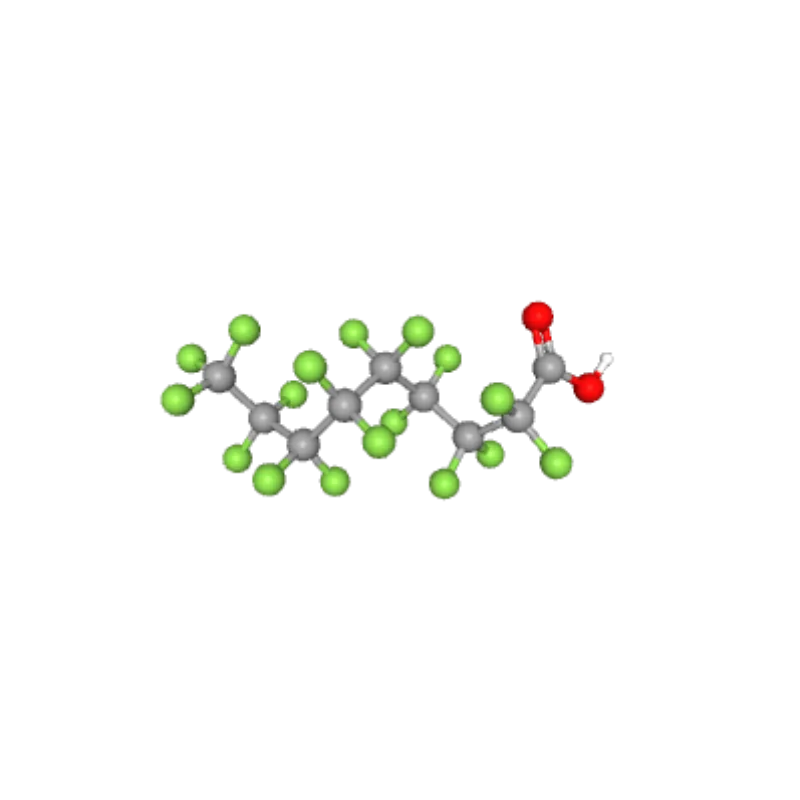
Chemistry + classification data sourced from public databases (PubChem, EPA CompTox, IARC monographs); 3D molecular models from 3d.nih.gov where available.