Understanding TDS: What Total Dissolved Solids Mean for Your Water
What TDS actually measures
Total Dissolved Solids — TDS — is the combined weight of every inorganic salt, mineral, and trace organic compound that's small enough to slip past a 2-micron filter and stay suspended in your water. The number is reported in parts per million (ppm) or the equivalent milligrams per liter (mg/L): 1 ppm = 1 mg of dissolved material per liter of water.
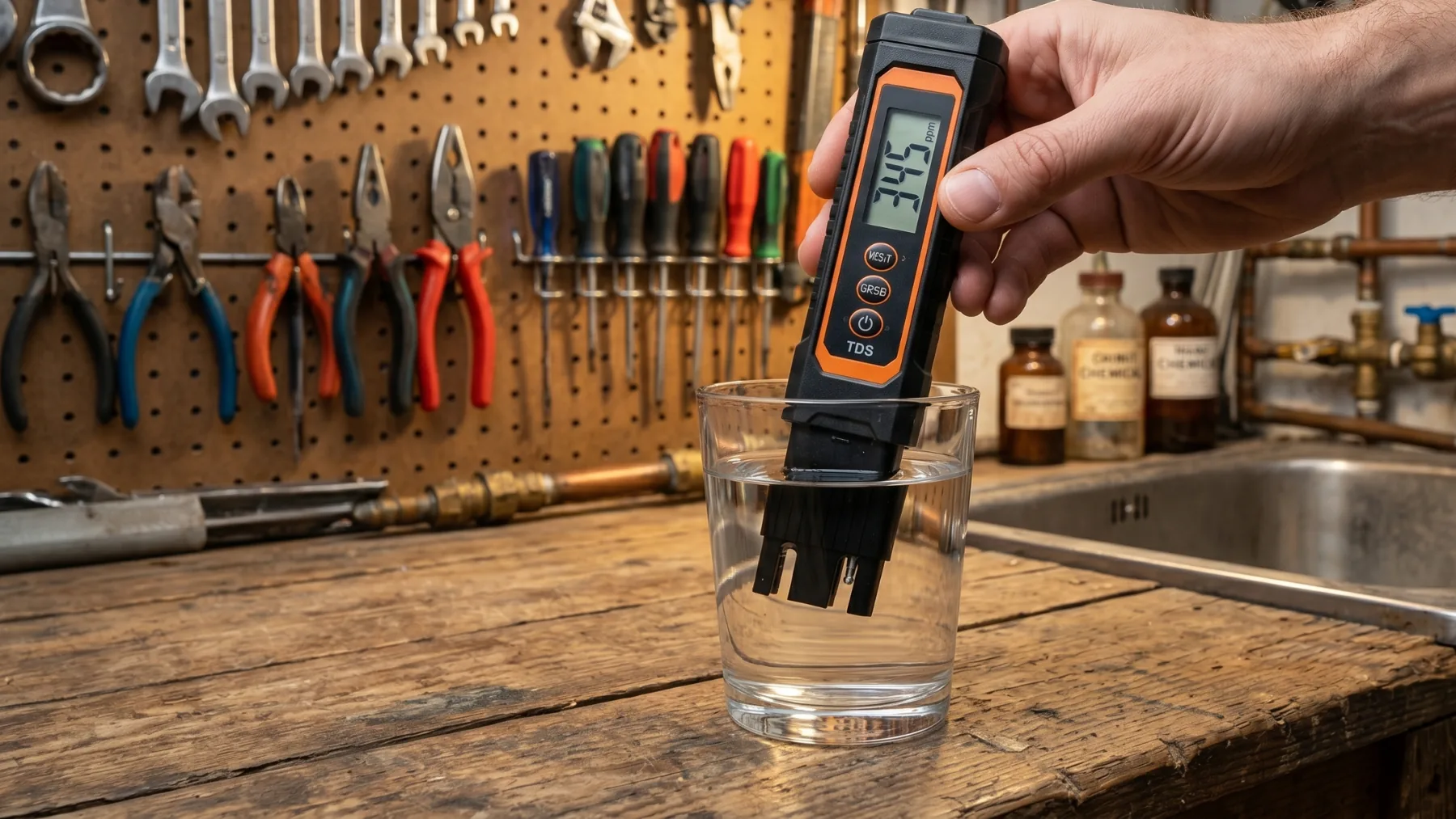
A handheld TDS meter doesn't actually weigh the dissolved solids — it measures the water's electrical conductivity and converts that reading using a fixed factor. That's why two waters with the same TDS reading can have wildly different mineral compositions: a meter can't tell calcium from sodium.
What's typically in your TDS reading
Most of the dissolved solids in tap water are harmless minerals — calcium, magnesium, sodium, potassium, bicarbonate. These are what give water its taste, and they're the reason fully distilled water tastes flat. But TDS also captures the contaminants you actually care about: lead, nitrates, sulfates, fluoride, and any soluble industrial residue.
Because the meter can't distinguish, a low TDS reading isn't proof of safe water and a high TDS reading isn't proof of dangerous water. It's a single-number health check — useful as a trend, not a verdict.
What's a healthy range
The EPA's secondary standard for drinking water is 500 ppm. That's an aesthetic guideline (taste, scale buildup) rather than a health limit. Common ranges:
- 0–50 ppm — Demineralized / RO output. Tastes flat unless remineralized.
- 50–150 ppm — Soft, low-mineral municipal water. Pleasant taste.
- 150–300 ppm — Typical municipal supply in most US cities.
- 300–500 ppm — Hard water territory. Scale on fixtures, but still within EPA aesthetic limits.
- 500–1000 ppm — Noticeably hard or salty taste. Worth filtering.
- 1000+ ppm — Some private wells, brackish sources. RO strongly recommended.
A quick caveat on that word "hard": TDS isn't actually a hardness measurement. Hardness refers specifically to calcium and magnesium, while TDS sums every dissolved ion — sodium, potassium, bicarbonate, chloride, and the rest. The two correlate (high-TDS water is often hard), but they aren't the same number, so don't read a TDS meter as a hardness test. Water can be high in TDS yet relatively soft if much of that total is sodium rather than calcium and magnesium.
If you're switching from city water to a well, the TDS reading is the first thing to check — well water can swing 5× higher than the municipal supply two miles away.
How RO reduces TDS
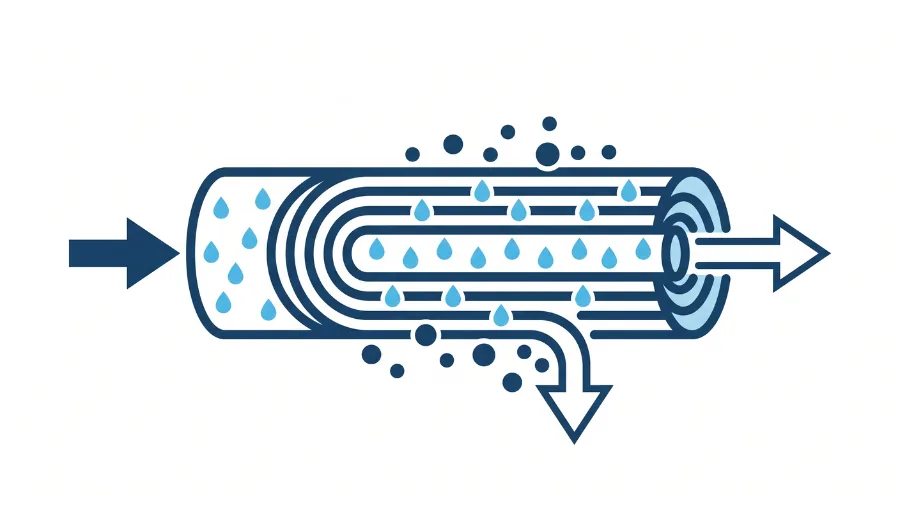
Reverse osmosis is the only filtration method that meaningfully lowers TDS. Carbon filtration removes chlorine, taste, and some organics, but it doesn't touch dissolved minerals. An RO membrane's pore size is roughly 0.0001 microns — small enough to exclude almost every dissolved ion.
A healthy RO system reduces TDS by 95–99%. If your input water reads 300 ppm and your post-RO reading is 6–15 ppm, the membrane is working as designed. A reading above ~30 ppm post-RO is a signal that the membrane is fouling or near end of life.
A practical workflow
- Buy a TDS meter — they're $15 and accurate to within ±2%.
- Test your tap water at the same faucet, same time of day, weekly for two weeks. Note the range.
- If you have an RO system, test the post-RO output too. The ratio (post / pre) tells you membrane health.
- If your tap reads consistently above 300 ppm, pick an RO system that fits your install and monitor the before/after reading once a month after installation.
TDS is a blunt instrument — but it's the cheapest, fastest signal you have, and it catches problems weeks before a full lab panel would tell you anything.